


Deep well plate in Cell Culture Application
Deep well plate , also known as deep-well microplates or deep-well blocks, are essential tools in cell culture applications, particularly when handling large volumes and high-throughput processes. These plates, typically available in 96 or 384-well formats, are specifically designed to accommodate larger sample volumes compared to standard microplates.
Their design allows for significant sample volumes, often up to several milliliters per well, making them ideal for extensive cell culture work. This capacity is particularly beneficial in high-throughput screening, enabling researchers to grow, maintain, and analyze large numbers of cell cultures simultaneously. The increased depth of the wells also minimizes evaporation, ensuring more consistent culture conditions over extended periods, which is crucial for experiments requiring long-term cell growth and viability.
Deep well plates are extensively used in a variety of cell culture applications, including bacterial, yeast, and mammalian cell cultures. They provide a robust platform for experiments that require the cultivation of microorganisms or cells in larger volumes, such as drug screening, genetic studies, and protein production. Additionally, their compatibility with automated liquid handling systems enhances efficiency and reproducibility, streamlining workflows in both research and industrial settings.
high
quality
Advanced
Equipment
Professional
Team
One-Stop
Solution
high quality
advanced equipment
professional team
global shipping
In short, deep well plates are indispensable in cell culture, especially for managing large numbers of cells and high-throughput tasks, making them a key tool in modern laboratory workflows. The following are some deep well plate products:

Round Bottom Deep Well Plate
Round Bottom Deep Well Plate
A 96 deep well plate 2ml is a type of laboratory consumable that is commonly used for a wide range of applications in the life sciences, including high-throughput screening, sample storage, and sample preparation.

V-Bottoms Deep Well Plates
V-bottom deep well plates are specialized laboratory consumables used for various applications such as sample storage, cell culture, and high-throughput screening. These plates feature a V-shaped bottom design, which facilitates optimal sample recovery and reduces residual volume.

Round Well U Bottom Deep Well Plate
The Round well U bottom deep well plate is a popular laboratory product that offers several benefits and advantages. The U-shaped bottom design of this deep well plate allows for easy and efficient sample recovery, reducing the risk of sample loss or cross-contamination.

2 Ml 96 Well Plate
The 2 ml 96-well plate is a versatile laboratory consumable designed for sample storage and analysis. Each well has a 2 ml capacity, providing ample space for various liquid samples. Made from high-quality materials, these plates ensure reliable performance in applications such as PCR, sample dilution, and biochemical assays.
 1.5 Ml Pcr Tubes
Experience the reliability and precision of our 1.5 ml PCR Tubes! Trust in their quality and compatibility to deliver accurate results in your PCR experiments. Choose our PCR tubes for efficient and trustworthy sample preparation and analysis in your molecular biology research.

Microwell Deep Well Plate
The Microwell Deep Well Plate is a laboratory accessory that is designed for sample preparation, storage, and high-throughput screening. It is made from high-quality materials such as polypropylene, which is known for its excellent chemical resistance, durability, and thermal stabilityLarge-Scale Bacterial and Yeast Cultures
Products Description
High Capacity
Large Volume Handling: Deep well plates have a greater volume capacity per well compared to standard plates, allowing for the cultivation of larger cell volumes. This is particularly useful for producing sufficient quantities of cells or cell-derived products.
Concentration Studies: The ability to handle larger volumes supports studies that require high cell densities or the concentration of secreted products, such as antibodies or metabolites.
Enhanced Experimental Efficiency
High Throughput: Deep well plates enable high-throughput screening and processing, which is essential for large-scale experiments and drug discovery projects. Multiple samples can be cultured and analyzed simultaneously.
Automation Compatibility: These plates are designed to be compatible with automated liquid handling systems, reducing manual labor and the potential for human error, thus increasing throughput and reproducibility.
Improved Sample Integrity
Reduced Evaporation: The deeper wells reduce the risk of evaporation, maintaining consistent media volumes and concentrations over longer incubation periods. This is crucial for maintaining cell health and experimental integrity.
Contamination Control: The design of deep well plates often includes tight-fitting lids or sealing options that minimize the risk of contamination from external sources.
Versatility
Diverse Applications: Deep well plates can be used for various cell culture applications, including suspension cultures, adherent cell cultures, and spheroid formation. They are also suitable for bacterial and yeast cultures.
Adaptability: They are compatible with a range of assays and analytical techniques, such as ELISA, flow cytometry, and high-content imaging, making them versatile tools in cell biology research.
Efficient Media Exchange
Media Changes: The larger well volume facilitates easier media exchanges and feeding schedules without disturbing the cells, which is particularly beneficial for long-term culture experiments.
Harvesting Cells: The design of deep well plates allows for efficient harvesting of cells and supernatants, which is essential for downstream applications like protein extraction or RNA/DNA isolation.
Enhanced Data Management
Standardized Format: The standardized format of deep well plates facilitates consistent data collection and comparison across experiments and laboratories.
Traceability: Many deep well plates come with labeling or barcoding options, improving sample traceability and data management, which is crucial for maintaining accurate records and reproducibility.
Deep Well Plate can be used in these areas
Deepwell plates, with their deep well design, are key to high-volume cell culture experiments. Unlike standard microplates, each well of a deepwell plate can hold several milliliters of culture medium. This capacity is particularly beneficial for experiments that require large cell growth, such as scalability studies and large-scale production processes in the biotech and pharmaceutical industries.
The ability to hold large amounts of culture medium is a design feature that meets the need to efficiently process large numbers of cells, whether producing recombinant proteins, performing high-throughput screening, or culturing cells for biomedical research purposes. Researchers and biotechnologists rely on these plates to maintain stable and consistent cell cultures over extended periods of time, ensuring reliable experimental results.
In bioprocessing and biomanufacturing, deepwell plates play a vital role in scaling up cell culture operations. They provide a controlled environment that is conducive to cell proliferation, optimizing conditions for maximum productivity. This scalability is essential to meet the needs of large-scale production of biologics, vaccines, and therapeutic proteins, where maintaining cell viability and productivity is critical.
In addition, the deep wells of these plates minimize the risk of evaporation, which is essential to maintaining the integrity of the culture environment. This feature helps maintain stable pH, nutrient concentrations, and oxygenation, all of which are essential to support healthy cell growth and minimize experimental variability.
In summary, deep-well plates are an indispensable tool in modern cell culture laboratories and bioprocessing facilities, providing unparalleled capabilities for large-volume cell culture experiments. Their deep-well design allows efficient scale-up of cell culture operations, ensuring optimal growth conditions and reliable results in a variety of biomedical and biotechnology applications.

High-throughput screening (HTS)
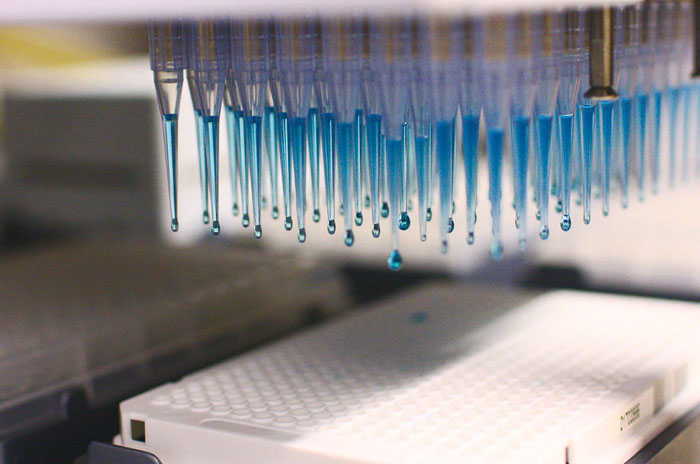
High-throughput screening (HTS) is a key approach in modern biomedical and pharmaceutical research, and deep-well plates play a key role in facilitating such experiments. These plates are specifically designed to handle large numbers of samples and facilitate testing of multiple compounds or genetic manipulations simultaneously, making them an indispensable tool in drug discovery, gene editing, RNA interference, and other fields where screening efficiency and scalability are critical.
The ability of deep-well plates to accommodate large volumes of samples and reagents is an essential feature that supports their use in HTS. Unlike standard microplates, which may not hold enough volume for a wide range of screening experiments, deep-well plates have wells that can hold several milliliters of liquid. This greater capacity enables researchers to perform large-scale assays, which is necessary for screening libraries of compounds or testing large numbers of genetic constructs simultaneously.
In drug discovery, for example, HTS using deep-well plates enables pharmaceutical researchers to screen thousands to millions of compounds for their potential therapeutic effects. By automating the process of adding test compounds and monitoring biological responses, deep-well plates streamline screening workflows, reducing the time and resources required to identify promising drug candidates. This efficiency is critical to accelerating drug development and increasing the likelihood of discovering new treatments for a variety of diseases.
The design of deep-well plates also supports compatibility with automated liquid handling systems, which improves the precision and reproducibility of experiments. Automated systems can perform tasks such as dispensing reagents, transferring cells, and performing assays with minimal human intervention, thereby reducing experimental variability and increasing throughput. This automation not only speeds up data generation, but also improves the reliability and consistency of experimental results across different screening campaigns.
Long-term cell culture experiments require stable and controlled conditions to ensure the health and viability of cells over extended periods of time, and deep-well plates are specifically designed to effectively meet these needs. Their unique deep-well design minimizes evaporation, providing a more stable environment for cell growth compared to standard microplates. This feature is essential for maintaining consistent experimental conditions, which is critical for obtaining reliable and reproducible research results.
The reduction in evaporation in deep-well plates helps prevent fluctuations in pH, osmolarity, and nutrient concentrations in the culture medium. These factors are essential to support optimal cell growth and metabolic activity over long periods of time, from days to weeks or even longer studies. By minimizing environmental changes, deep-well plates support the culture of a wide range of cell types, including sensitive cell lines and primary cells, ensuring that experimental conditions closely resemble physiological conditions.
In biomedical research and drug discovery, long-term cell culture in deep-well plates is essential for studying how cells respond to different treatments or environmental factors over time. For example, researchers can use these plates to evaluate the effects of candidate drugs on cell proliferation, apoptosis, or differentiation pathways in a controlled manner. The stability provided by deep-well plates allows for continuous monitoring of cell behavior without the need for frequent media changes or adjustments, thereby reducing experimental disturbances and improving data reliability.
In addition, the scalability of deep-well plates makes them suitable for scaling up experiments that require large numbers of cells or large amounts of media. This capability is particularly advantageous in the biotech and pharmaceutical industries, where producing consistent batches of cells is critical for downstream applications such as protein expression, vaccine development, or toxicity testing.
The compatibility of deep-well plates with automated liquid handling systems further enhances their usefulness in long-term cell culture experiments. Automated systems can perform routine tasks such as media exchange, cell seeding, and sample collection precisely and reproducibly, minimizing labor-intensive manual interventions and reducing the risk of contamination or human error.

Automated Handling

The compatibility of deep-well plates with automated liquid handling systems represents a major advancement in laboratory automation, revolutionizing the efficiency and precision of a wide range of cell culture operations. Deep-well plates feature deep and spacious wells that accommodate large volumes of culture media, facilitating seamless integration with automated systems designed for precise liquid dispensing, sample handling, and data acquisition.
Automated liquid handling systems offer multiple benefits when used with deep-well plates. They enable researchers to perform high-throughput tasks such as cell seeding, media exchange, compound addition, and cell harvesting with unmatched accuracy and consistency. This automation minimizes human intervention, reduces the risk of errors associated with manual handling, and ensures experimental reproducibility.
In cell culture applications, automated media exchange in deep-well plates supports long-term cell culture experiments by maintaining optimal nutrient levels and pH balance without disrupting cell growth. This continuous monitoring and replenishment of culture media reduces the need for human intervention, allowing researchers to focus on data analysis and experimental design rather than routine maintenance tasks.
Integration of deep-well plates with automated systems also improves workflow efficiency in drug discovery and screening applications. Researchers can screen large libraries of compounds or genetic constructs in a systematic and high-throughput manner, accelerating the identification of potential drug candidates or biological targets. Automated data collection and analysis further streamlines the process, enabling real-time monitoring of cellular responses and facilitating rapid decision-making in experimental protocols.
Maybe you would like to know the following questions
1. What is a deep well plate, and how does it differ from standard microplates in cell culture applications?
Deep well plates, also known as deep-well microplates or blocks, are specialized laboratory tools designed with deeper wells compared to standard microplates. These wells can typically hold larger volumes of liquid, ranging from hundreds of microliters to several milliliters per well. This larger capacity makes deep well plates ideal for cell culture applications where scalability, high throughput, and maintaining stable conditions over extended periods are essential. Unlike standard microplates, which are shallow and have limited volume capacity, deep well plates provide a more robust platform for various cell culture experiments.
2. What are the primary advantages of using deep well plates in cell culture?
Deep well plates offer several advantages in cell culture:
Capacity: They can accommodate larger volumes of media, allowing for higher cell densities and longer-term culture without frequent medium changes.
Reduced evaporation: The deeper wells minimize evaporation, maintaining stable pH, osmolarity, and nutrient concentrations crucial for cell growth.
High throughput: Suitable for handling multiple samples simultaneously, facilitating high-throughput screening and experimentation.
Compatibility with automation: Enable automated liquid handling systems, enhancing workflow efficiency, reducing errors, and improving reproducibility.
3. How are deep well plates used in scaling up cell culture experiments?
Scaling up cell culture involves increasing the volume and number of cells grown, typically for producing biologics, vaccines, or conducting large-scale experiments. Deep well plates provide a controlled environment conducive to cell growth and scalability. Researchers can seed cells in multiple wells, maintain consistent culture conditions, and perform parallel experiments to generate sufficient quantities of cells for downstream applications. This scalability is crucial in biotechnology and pharmaceutical industries where large volumes of cells are required for production or screening purposes.
4. What are the specific techniques and protocols used with deep well plates in cell culture?
Several techniques and protocols are employed with deep well plates in cell culture:
Seeding cells: Ensuring even distribution of cells across wells using automated pipetting systems.
Media exchange: Performing regular or automated media changes to replenish nutrients and remove waste products.
Treatment assays: Adding compounds, drugs, or inducers to assess cellular responses.
Long-term culture: Maintaining cells over extended periods while monitoring growth, viability, and phenotypic changes.
Harvesting cells: Collecting cells for downstream analysis or further experimentation.
These techniques are optimized to maximize cell viability, minimize contamination risks, and ensure consistent experimental conditions.
5. How do deep well plates contribute to maintaining stable conditions for long-term cell culture?
The deep wells of these plates significantly reduce evaporation, which helps maintain stable conditions necessary for long-term cell culture. Stable conditions include maintaining optimal pH levels, osmolarity, and nutrient concentrations critical for cell viability and growth. This stability is essential for conducting experiments that require cells to be cultured for days, weeks, or even months without compromising their physiological integrity or experimental outcomes.
6.What are the current trends and future directions in the use of deep well plates for cell culture?
Current trends in the use of deep well plates for cell culture include:
Integration with advanced analytics: Incorporating high-content imaging, omics technologies (such as genomics, proteomics), and single-cell analysis.
Application in personalized medicine: Utilizing deep well plates for patient-derived cell cultures to study individual responses to treatments or diseases.
Automation of complex assays: Developing automated systems capable of performing multi-step assays, including cell differentiation or organoid culture.
Microfluidics integration: Exploring microfluidic technologies within deep well plate formats for precise control over cell microenvironments.
Future directions may involve enhancing the compatibility of deep well plates with emerging technologies and expanding their application in tissue engineering, regenerative medicine, and therapeutic development.
In conclusion, deep well plates are versatile tools that have revolutionized cell culture practices by enabling scalable, high-throughput, and stable conditions essential for various biomedical and biotechnological applications. Their integration with automation systems continues to drive efficiency, reproducibility, and innovation in cell biology research, paving the way for advancements in understanding disease mechanisms, drug discovery, and personalized medicine. As technologies evolve, deep well plates will remain integral to advancing scientific knowledge and improving human health outcomes through robust cell culture methodologies.