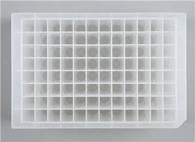





96-Well Configuration
The deep 96-well plate features 96 individual wells, each designed to handle a larger liquid volume compared to standard 96-well plates. This configuration is ideal for high-throughput applications, where processing multiple samples at once is necessary. Researchers can streamline experiments by simultaneously managing a variety of samples or compounds, making it suitable for large-scale projects such as drug screening, enzyme assays, protein expression studies, and high-throughput screening (HTS). The 96-well configuration maximizes experimental efficiency by allowing for parallel analysis of multiple samples, significantly reducing overall processing time and improving throughput.
Increased Well Depth
The deep well design provides substantial volume capacity per well, typically ranging from 1 to 2 milliliters. This depth facilitates the use of larger sample volumes, which is particularly advantageous when working with concentrated samples, complex chemical reactions, or incubations requiring longer periods. The additional well depth also allows for more reagent storage, making it easier to conduct serial dilutions, reactions requiring multiple components, or tests involving larger quantities of material. This added depth is especially valuable in biochemical and molecular biology experiments, where more substantial sample sizes are often required for reproducibility and precision.
Thermal Resistance
One of the key advantages of the deep 96-well plate is its ability to withstand extreme temperatures, making it versatile for use in both high and low-temperature applications. The plate is capable of enduring high-temperature sterilization (e.g., autoclaving at 121°C) while maintaining its structural integrity. In addition, it is ideal for use in cold storage environments, such as freezers that operate as low as -80°C, ensuring that samples can be stored or transported without risk of degradation. This temperature resistance is crucial for experiments that require precise temperature control, including sample preservation, cold reactions, and maintaining sample stability over long periods.
Sterility and Biocompatibility
The deep 96-well plate is often sterilized through gamma irradiation or other effective sterilization techniques to ensure it is free from contaminants, making it suitable for sensitive biological or medical applications. Sterility is crucial when working with cell cultures, DNA/RNA extraction, or other sensitive assays where contamination can lead to skewed results. Furthermore, the biocompatible materials used in the plate's construction make it safe for use in experiments that involve live cells or other biological materials. By ensuring a contamination-free environment, the plate helps researchers achieve more accurate, reliable, and reproducible results in sensitive experiments such as drug discovery and genetic research.
Material composition and features

Guarantee of stability and durability
The high-quality polypropylene (PP) material used in the deep 96-well plate has excellent mechanical strength and exhibits strong impact resistance when facing external pressure and impact during the experiment. This allows the product to maintain structural integrity under high-intensity use and is not easy to break or deform. For example, in fields that require high durability such as high-throughput screening and drug screening, the deep 96-well plate made of polypropylene can withstand repeated operations and large mechanical pressure, effectively avoiding damage caused by external collisions or extrusion, and providing long-term stable support. This mechanical strength is especially important in experiments such as high-pressure sample operations and enzyme reactions, ensuring stable performance under harsh experimental conditions, extending service life and reducing replacement frequency.
Ensure experimental accuracy and reliability
In addition to mechanical strength, polypropylene (PP) also has excellent chemical resistance and can resist corrosion from a variety of chemical reagents. Whether it is strong acids, strong bases, or common chemicals such as organic solvents, polypropylene can maintain its stability and avoid adverse reactions, which makes the deep 96-well plate widely used in many industries such as chemistry, medicine and biology. In experiments, especially when complex chemical reactions or corrosive solutions are involved, the chemical stability of the material is crucial. If the material used reacts with the chemical reagents, it may cause sample contamination, distorted experimental results or damage to the equipment. The excellent performance of polypropylene in this regard effectively avoids these risks and ensures the purity of the sample and the accuracy of the experiment.

Application areas of deep 96 well plate
High-throughput screening (HTS)
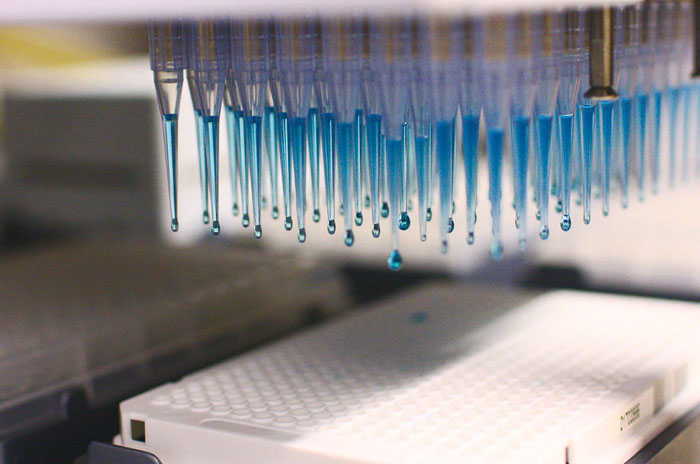
Deep 96-well plates play a vital role in high-throughput screening (HTS) applications, especially in drug discovery and biomedical research. Its 96 independent wells design allows each experiment to process up to 96 samples simultaneously, significantly improving screening efficiency. During the drug screening process, researchers can test the effects of different compounds in the same experiment, thereby speeding up the drug development process and shortening the experimental cycle. Through high-throughput screening, a large amount of data can be obtained in a short period of time, identifying potential drug candidates, optimizing drug combinations, and even conducting in-depth studies of disease mechanisms. In addition, the design of the deep 96-well plate allows researchers to conduct comparative analyzes of different experimental conditions at multiple points in the same experiment in parallel, thereby more efficiently evaluating different activities or responses of drugs.
Sample storage and handling
Deep 96-well plates also have obvious advantages in sample storage and handling. Each well is designed with a large volume, typically holding 1 to 2 ml of liquid, making it ideal for storing and handling biological samples, chemical reagents, and reaction solutions. Compared with traditional shallow-well plates, deep-well plates can effectively reduce the risk of sample evaporation or contamination. Especially when long-term storage is required, such as when biological samples are stored in low-temperature environments (such as -80°C), they can provide stability. storage conditions. In biological experiments, deep-well plates are widely used to preserve cell culture fluids, blood samples, virus samples, etc., which can ensure that samples maintain stability under low temperature conditions and avoid degradation. For scenarios where a larger volume of reaction solution or multiple solvents need to be added during the experiment, the deep 96-well plate can also be easily handled to ensure the efficient conduct of each reaction.

Maybe you have the following questions
Q: 1. Is this product suitable for high-throughput screening (HTS) experiments?
A: Yes, this product is ideal for high-throughput screening (HTS) experiments. It is designed to support the simultaneous processing of up to 96 samples or reagents, thus significantly improving the efficiency of experiments. Whether in drug screening, genetic research, or enzyme activity testing, this product can be used to test multiple samples at the same time, ensuring the smooth progress of large-scale experiments and increasing the speed of screening and analysis.
Q: 2. What extreme environmental conditions can it withstand?
A: This product has good high temperature and low temperature resistance. It can withstand the high-pressure steam sterilization process up to 121°C, ensuring no deformation or damage during sterilization. In addition, it is also suitable for use at extremely low temperatures, such as -80°C, which makes it particularly good at biological sample storage and long-term freezing experiments.
Q: 3. In terms of material, is the product suitable for chemical experiments?
A: Yes, the material of this product can withstand a variety of chemical reagents, including strong acids, alkalis, and organic solvents. This means that it will not react with reagents when conducting chemical experiments, thus ensuring the accuracy of experimental results. In chemistry, drug development and biomedical research, the chemical stability of materials is very important, and the high chemical stability of this product is one of its advantages.
Q: 4. Is this product compatible with laboratory automation equipment?
A: Yes, this product has a standardized hole design, ensuring that it is compatible with a variety of laboratory automation equipment, such as multi-channel pipettes, automated liquid handling systems, and automated high-throughput screening platforms. The design of standard sizes and hole spacing allows researchers to easily implement automated operations, improve the efficiency of experiments, and reduce errors caused by human operations.
Q: 5. Is the product available in a sterile version?
A: Yes, this product is available in a sterile version that uses irradiation or other appropriate sterilization methods to ensure that each well plate reaches sterility standards before use. The sterile version is very suitable for experiments with extremely high contamination requirements such as cell culture and DNA/RNA extraction, and can effectively avoid the impact of microbial contamination on experimental results.
Q: 6. Is it suitable for long-term sample storage?
A: This product is ideal for long-term sample storage, especially in low temperature environments. It can store samples at low temperatures of -80°C, ensuring that samples are effectively protected from deterioration or degradation even under extreme low temperature conditions. Therefore, this product is widely used in sample storage and long-term preservation in the fields of biomedicine and life sciences.
Q: 7. Will the use of this product affect sample processing during the experiment?
A: Won't. The design of this product ensures that each well is independent and uniform, avoiding cross-contamination or interference between samples. In addition, the deep hole design helps reduce evaporation or spillage of liquid and ensures the stability of the sample during the experiment, especially suitable for experiments requiring larger liquid capacity. These designs enable higher accuracy and reliability in applications such as high-throughput screening, enzymatic reactions, and sample storage.
Hot Tags: deep 96 well plate, China, suppliers, manufacturers, factory, custom, wholesale, for sale, Low Binding Pipet Tip, Round well U bottom deep well plate, 1000 l Filter Universal Pipette Tip, Conductive Filterd Pipette Tip, 200 L pipette, 0 2ml Pcr Microplate