







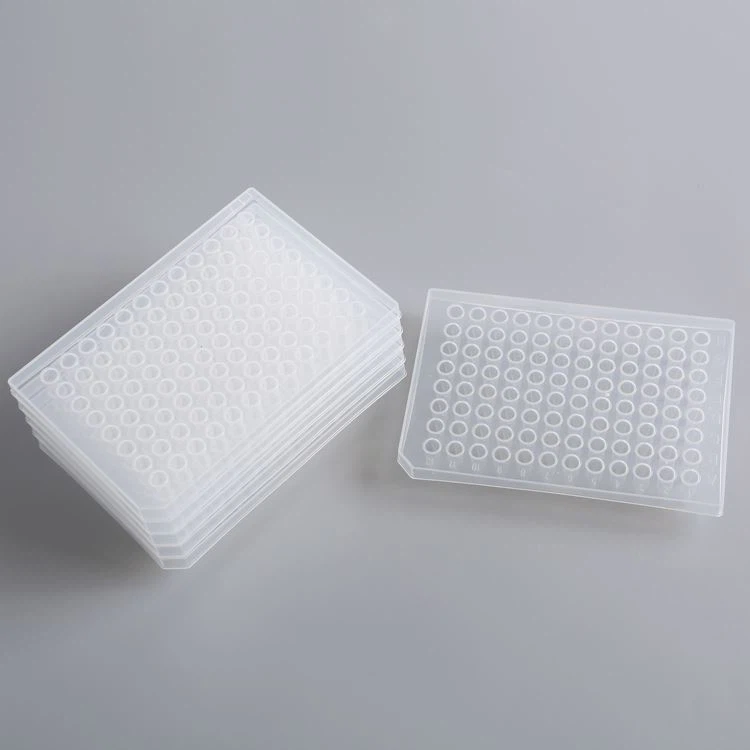
96 well pCR microplate & strips
Well number and layout
There are 96 independent reaction wells on the 96-well PCR microplate, which are usually distributed in a matrix of 8 rows and 12 columns (8×12). This layout design is not only convenient for operation on a standard experimental platform, but also maximizes the use of space, so that each well can react separately. Each well can be independently tested, so that up to 96 samples can be processed simultaneously in one experiment, which greatly improves the efficiency and yield of the experiment.
Material
This microplate is usually made of polypropylene (PP) or polystyrene (PS). These two materials have good high temperature resistance and chemical inertness, which can ensure that the microplate will not deform or release harmful substances during PCR thermal cycling. Polypropylene (PP) is usually the preferred material due to its excellent heat resistance and chemical corrosion resistance, while polystyrene (PS) is also widely used due to its transparency and lower cost. In order to further improve the accuracy and reliability of the experiment, some microplates are also specially treated during the production process to ensure that there are no DNase and RNase on their surface, thereby avoiding sample degradation and contamination.
Well volume
The volume of each well is usually between 100 and 200 microliters, but there are also microplates with larger or smaller designs to meet the needs of different experiments. This flexibility allows the 96-well microplate to adapt to various types of PCR experiments, including quantitative PCR (qPCR) and high-throughput screening experiments. Smaller wells are suitable for experiments with limited sample amounts, while larger wells are suitable for experiments that require more reaction mixtures. In addition, the design of the microplate takes into account thermal conductivity, ensuring that the temperature of each well is uniform, thereby optimizing the PCR reaction conditions and improving the accuracy and consistency of experimental results.
Function and use
The main function of the 96-well PCR microplate is to provide a reliable reaction platform in PCR experiments. PCR (polymerase chain reaction) is a widely used technology for gene amplification and analysis, which can amplify a small amount of DNA sample to a sufficient amount for further analysis and operation. The design of the 96-well microplate enables it to process multiple samples simultaneously in one experiment, improving the efficiency of the experiment and high-throughput screening capabilities. This is particularly important for research that requires processing a large number of samples, especially in the fields of genomics and drug screening.
Material characteristics of this product

96-well PCR microplates are usually made of polypropylene (PP) or polystyrene (PS). These two materials are widely used for their excellent high temperature resistance and chemical inertness, ensuring that the microplate will not deform or release harmful substances during PCR thermal cycling. Polypropylene (PP) is usually the preferred material due to its excellent heat resistance and chemical corrosion resistance. It can remain stable under high temperature conditions and does not react with reagents, thus ensuring the accuracy of the experiment. Polystyrene (PS) is also widely used due to its transparency and low cost. It is particularly suitable for experiments requiring optical detection, such as fluorescent quantitative PCR (qPCR). Its transparent properties help to improve the sensitivity of detection.
In order to further improve the accuracy and reliability of the experiment, some microplates are also specially treated during the production process. The first is the DNase and RNase-free treatment. This treatment method ensures that there is no residual nuclease on the surface of the microplate, thereby avoiding sample degradation and contamination. This is particularly important for accurate detection in molecular biology experiments, because the presence of any exogenous enzymes may lead to sample degradation or inaccurate experimental results.
In addition, some microplates also have a low adsorption surface treatment, which reduces the adsorption of samples and reagents and improves the accuracy and repeatability of reactions. This ensures that more reagents participate in the reaction rather than being adsorbed on the microplate wall, thereby improving the efficiency of the experiment and the reliability of the results.
In order to further improve the accuracy and reliability of the experiment, some microplates are also specially treated during the production process. The first is the DNase and RNase-free treatment. This treatment method ensures that there is no residual nuclease on the surface of the microplate, thereby avoiding sample degradation and contamination. This is particularly important for accurate detection in molecular biology experiments, because the presence of any exogenous enzymes may lead to sample degradation or inaccurate experimental results.
In addition, some microplates also have a low adsorption surface treatment, which reduces the adsorption of samples and reagents and improves the accuracy and repeatability of reactions. This ensures that more reagents participate in the reaction rather than being adsorbed on the microplate wall, thereby improving the efficiency of the experiment and the reliability of the results.

Specific application of this product in the field of PCR reaction
The 96-well microplate in the PCR experiment is specially designed for PCR reaction, and each well can independently perform DNA amplification reaction. This design enables researchers to process up to 96 samples simultaneously in one experiment, greatly improving experimental efficiency and data processing capabilities. In the PCR reaction, reagents such as DNA samples, primers, nucleotides and polymerase are added to each well, and then a series of heating and cooling cycles are performed through a thermal cycler to achieve DNA denaturation, annealing and extension. Each well is an independent reaction system that does not interfere with each other, ensuring accuracy and reliability in high-throughput experiments. In addition, the standardized design of the microplate makes it compatible with various automated equipment, further improving the efficiency and repeatability of the experiment.
This design is of great significance for gene amplification. In gene amplification experiments, the 96-well microplate provides an efficient platform for rapid amplification of target DNA sequences, allowing a small amount of DNA samples to be amplified to a detectable level. This is very important for applications such as genetic research, disease diagnosis, and gene cloning. Using a 96-well microplate for PCR reaction can not only process multiple samples at the same time, but also ensure that the temperature of each reaction well is evenly distributed, thereby optimizing the reaction conditions and improving the amplification efficiency and product quality. High-quality amplification products are the basis for subsequent gene analysis and experimental operations, ensuring the accuracy and repeatability of experimental results.

Maybe you have the following questions
1: What is the main purpose of this product?
This product is mainly used for polymerase chain reaction (PCR) experiments and is a key tool in molecular biology and biochemistry laboratories. It can process 96 independent reactions at the same time, making high-throughput screening and analysis possible. This microplate is widely used in experiments such as gene amplification, gene expression analysis, mutation detection and gene cloning, providing an efficient platform for rapid analysis of a large number of samples.
2: What is the material of this product?
This product is usually made of polypropylene (PP) or polystyrene (PS). Polypropylene (PP) is widely used for its excellent heat resistance and chemical inertness. It can remain stable under high temperature conditions and does not react with reagents. Polystyrene (PS) is also widely used for its transparency and low cost. It is particularly suitable for experiments that require optical detection, such as fluorescent quantitative PCR (qPCR).
3: What is the volume of each well?
The volume of each well of this product is usually between 100 and 200 microliters, depending on the specific model and experimental requirements. Smaller volume wells are suitable for experiments with limited sample amounts, while larger volume wells are suitable for experiments that require more reaction mixtures. This flexibility enables the 96-well microplate to adapt to various types of PCR experiments, including quantitative PCR (qPCR) and high-throughput screening experiments.
4: How to prevent sample contamination during the experiment?
To prevent sample contamination during the experiment, this product is treated with DNase and RNase-free during the production process to ensure that there is no residual nuclease on the surface. In addition, the microplate can be sealed with an optically transparent film or a heat-sealed film to prevent sample evaporation and cross-contamination. At the same time, the high edge design also helps to reduce the risk of cross-contamination, especially when dealing with small volume samples.
5: Is this product compatible with automated equipment?
Yes, this product is designed with a standard size and is compatible with a variety of automated liquid handling workstations and thermal cyclers. This design not only improves the efficiency of the experiment, but also reduces the errors caused by human operation, thereby improving the repeatability and reliability of the experimental results. In modern laboratories, the application of automated equipment is becoming more and more widespread, and the compatibility of 96-well microplates greatly simplifies the experimental process.
6: What is special about the bottom design of this product?
The bottom design of this product is optimized to improve the sensitivity of optical detection. This is especially important for experiments that require fluorescence detection, such as quantitative PCR (qPCR). The transparent bottom helps to improve the intensity and stability of the detection signal, while the white bottom helps to reflect the fluorescent signal, improving the sensitivity and accuracy of the detection. The optimization of the bottom design ensures that the temperature of each reaction well is evenly distributed, optimizing the PCR reaction conditions.
7: What quality certifications should I pay attention to when purchasing this product?
When purchasing this product, you should pay attention to whether the product has undergone strict quality control and certification. ISO 9001 and ISO 13485 certifications are the standards of many manufacturers to ensure that their production processes and products meet international standards. These certifications indicate that the product has undergone rigorous quality testing to ensure its efficiency and reliability in experiments. In addition, choosing a microplate that has been treated with DNA and RNA enzymes can effectively avoid sample degradation and contamination during the experiment and improve the accuracy and consistency of the experimental results.
Hot Tags: 96 well pcr microplate, China, suppliers, manufacturers, factory, custom, wholesale, for sale, Red PCR Tubes, Low Binding Pcr Tubes, Conductive Filterd Pipette Tip, Polypropylene Pipette Tip, 300 L Pipette Tip, Round well U bottom deep well plate


