







PCR tubes, also known as PCR tubes 0.2 mL, are small plastic tubes used in Polymerase Chain Reaction (PCR) techniques for amplifying DNA fragments. These tubes have several features that make them ideal for PCR applications.
Firstly, PCR tubes are made of high-quality, medical-grade polypropylene, which is resistant to most chemicals, including enzymes and nucleotides. This ensures that the reaction is not affected by the presence of the tube material and produces consistent and reliable results.
Secondly, PCR tubes 0.2 mL have a thin, uniform wall thickness that allows for efficient and even heat transfer during thermal cycling. This ensures that the PCR reaction reaches the required temperature quickly and efficiently, reducing the time needed for the PCR reaction.
Thirdly, PCR tubes have a flat and smooth base that ensures the tube can stand upright on a flat surface and can be used with automated systems that require precise positioning of the tubes.
Fourthly, PCR tubes 0.2 mL are available in a range of colors, which allows for easy identification and tracking of samples during PCR analysis. The tubes are also available with attached caps, which minimizes the risk of contamination and loss of sample.
Finally, PCR tubes are available in bulk packs, which are economical and cost-effective, making them ideal for high-throughput PCR applications.
Overall, PCR tubes 0.2 mL are an essential tool in molecular biology research, and their high-quality construction and features make them ideal for PCR applications. Their uniform wall thickness, flat base, and range of colors and packaging options make them versatile and suitable for use in a wide range of laboratory settings.
Features:
1. Imported plastic material, no thermal decomposition product, no endotoxin
2. Excellent thermal conduction effect Sample amplification
3. Suitable for real-time PCR
3. Can be sterilized by high temperature and high pressure
4. Suitable for most automated experimental instruments
5. Can withstand the centrifugal force of the fully supported rotor: 6000G
Factory Advantage
1. Professional laboratory consumable manufacturer
2. GMP certification 100.000 purification workshop
3. TUV 13485 certification
4. Rich OEM&ODM experience
5.One-handed operation is convenient and simple
6.Accurate measurement outside the tube
7.DNase and RNase
8.Easy to sterilize
Related Products
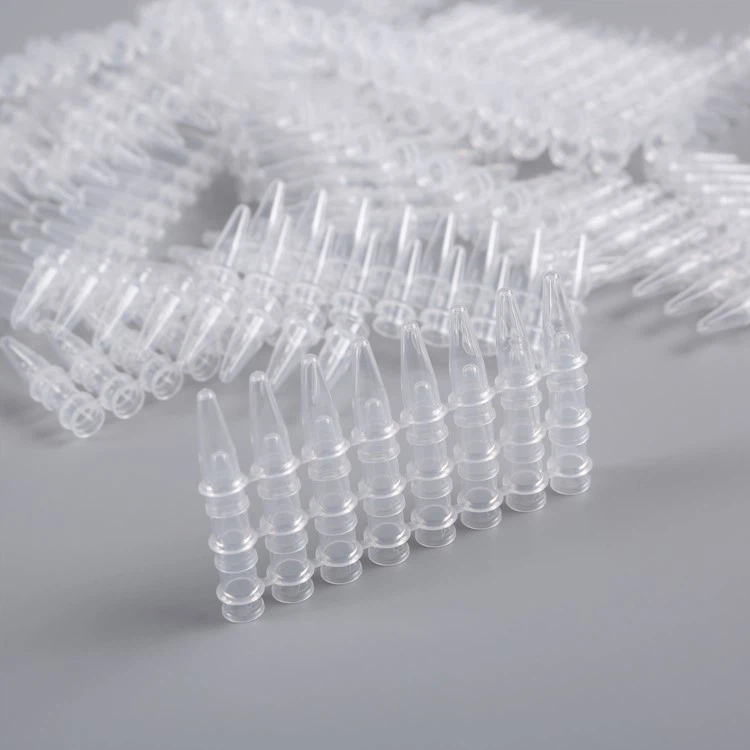
Pcr Tubes 0.2 mL offer several advantages in molecular biology experiments. Firstly, their compact 0.2 mL capacity ensures efficient use of reagents and facilitates high-throughput processing. This feature is particularly advantageous in PCR applications where small reaction volumes are often sufficient, minimizing reagent wastage.
Secondly, these tubes are meticulously designed to provide precise sample containment. The tight-sealing caps and clear markings contribute to the accuracy of sample handling, crucial for obtaining reliable results in DNA amplification workflows. The design features also help prevent cross-contamination, ensuring the integrity of experimental outcomes.

Thirdly, the Pcr Tubes are manufactured from high-quality materials with optimal thermal conductivity. This is essential for maintaining stable and uniform temperatures during PCR, enhancing the efficiency of the reaction. The tubes' compatibility with PCR processes, including thermal cycling, ensures consistent and reproducible amplification of DNA, crucial for reliable research outcomes.
Lastly, Pcr Tubes 0.2 mL offer convenience in storage and retrieval. Their compact size allows for efficient use of laboratory space and facilitates easy access during experiments. The tubes are often made from materials that withstand extreme temperature variations, ensuring the integrity of samples even during long-term storage.
typical application
PCR tubes are an essential item in the world of molecular biology and genetics research. These tubes are used for polymerase chain reaction (PCR) experiments, which are used to amplify specific regions of DNA or RNA in a process that involves multiple heating and cooling cycles.
One of the most important features of PCR tubes is their size. The most commonly used PCR tubes have a capacity of 0.2 ml, which is ideal for experimental setups that involve smaller amounts of DNA or RNA. This size allows for efficient amplification and minimizes the risk of contamination.
PCR tubes are typically made of polypropylene, which is a durable and flexible plastic that can withstand the high temperatures required for PCR experiments. One of the key benefits of polypropylene is that it is resistant to most chemicals, including detergents, acids, and bases, which helps to ensure accurate and reliable results when conducting PCR experiments.
PCR tubes also come in a variety of colors, which can be useful for experiment organization and sample tracking. Many manufacturers offer tubes in clear, white, and assorted colors, allowing researchers to easily differentiate samples and keep track of their experiments.
In addition to the standard 0.2 ml size, PCR tubes are also available in larger sizes, such as 0.5 ml and 1.5 ml, which can be useful for experiments that require larger volumes of DNA or RNA.
Overall, PCR tubes play a critical role in modern molecular biology research, allowing researchers to perform PCR experiments that are essential to many biological investigations. With their small size, durability, and chemical resistance, these tubes are a vital component in any lab conducting PCR experiments.


Factory Show


FAQ:
- What is the specific purpose of Pcr Tubes 0.2 mL in molecular biology experiments?
- How does the 0.2 mL capacity of these tubes benefit PCR applications?
- What materials are commonly used to manufacture Pcr Tubes for optimal thermal conductivity?
- Why is compatibility with PCR processes crucial for Pcr Tubes?
- In what ways do Pcr Tubes contribute to the reliability of DNA amplification workflows?
- Can you explain the design features that prevent cross-contamination in Pcr Tubes?
- What makes Pcr Tubes suitable for precise sample containment in PCR experiments?
- How do Pcr Tubes enhance the efficiency of polymerase chain reaction applications?
- Are there specific quality standards for the materials used in Pcr Tubes?
- What role does thermal conductivity play in the performance of Pcr Tubes during PCR?
- How are Pcr Tubes typically retrieved or accessed for sample handling?
- Are there variations in the design of Pcr Tubes based on different manufacturers?
- What are the primary considerations for choosing Pcr Tubes in molecular biology research?
- Can Pcr Tubes with a 0.2 mL capacity be used in high-throughput PCR applications?
- Are there any specific precautions or guidelines for using Pcr Tubes in DNA amplification?
- How do Pcr Tubes contribute to the precision of sample containment in PCR experiments?
- Are there advancements or innovations in the design of Pcr Tubes for improved performance?
- What characteristics define high-quality materials for manufacturing Pcr Tubes?
- How do Pcr Tubes address the challenges associated with thermal variations in PCR?
- Are there alternative technologies or products competing with Pcr Tubes in PCR applications?
1.What is the specific purpose of Pcr Tubes 0.2 mL in molecular biology experiments?
The specific purpose of Pcr Tubes 0.2 mL in molecular biology experiments is to provide a controlled environment for PCR reactions, ensuring accurate amplification of DNA sequences.
2.How does the 0.2 mL capacity of these tubes benefit PCR applications?
The 0.2 mL capacity benefits PCR applications by allowing precise measurement and containment of small sample volumes, optimizing reaction conditions.
3.What materials are commonly used to manufacture Pcr Tubes for optimal thermal conductivity?
Pcr Tubes are commonly manufactured using materials like polypropylene, ensuring optimal thermal conductivity for efficient heat transfer during PCR.
4.Why is compatibility with PCR processes crucial for Pcr Tubes?
Compatibility with PCR processes is crucial for Pcr Tubes to withstand temperature fluctuations, enzymatic reactions, and other conditions inherent to PCR.
5.In what ways do Pcr Tubes contribute to the reliability of DNA amplification workflows?
Pcr Tubes contribute to the reliability of DNA amplification workflows by offering consistent and reproducible results through their precise design and high-quality materials.
6.Can you explain the design features that prevent cross-contamination in Pcr Tubes?
Design features preventing cross-contamination in Pcr Tubes include secure seals and materials that inhibit DNA adhesion, ensuring sample integrity.
7.What makes Pcr Tubes suitable for precise sample containment in PCR experiments?
Pcr Tubes are suitable for precise sample containment in PCR experiments due to their accurate volume measurement and tight sealing properties.
8.How do Pcr Tubes enhance the efficiency of polymerase chain reaction applications?
Pcr Tubes enhance the efficiency of polymerase chain reaction applications by providing a controlled environment for DNA amplification reactions.
9.Are there specific quality standards for the materials used in Pcr Tubes?
Quality standards for Pcr Tubes include using certified materials to ensure purity, preventing interference with PCR reactions.
10.What role does thermal conductivity play in the performance of Pcr Tubes during PCR?
Thermal conductivity in Pcr Tubes is crucial for efficient heat transfer, optimizing temperature changes during denaturation, annealing, and extension in PCR.
11.How are Pcr Tubes typically retrieved or accessed for sample handling?
Pcr Tubes are typically accessed for sample handling using pipettes, ensuring precision and preventing contamination.
12.Are there variations in the design of Pcr Tubes based on different manufacturers?
Variations in the design of Pcr Tubes exist among different manufacturers, including differences in materials, cap designs, and additional features.
13.What are the primary considerations for choosing Pcr Tubes in molecular biology research?
Primary considerations for choosing Pcr Tubes in molecular biology research include sample volume requirements, compatibility, and reliability.
14.Can Pcr Tubes with a 0.2 mL capacity be used in high-throughput PCR applications?
Pcr Tubes with a 0.2 mL capacity can be used in high-throughput PCR applications, offering efficiency in processing numerous samples.
15.Are there any specific precautions or guidelines for using Pcr Tubes in DNA amplification?
Precautions for using Pcr Tubes include avoiding contamination, using proper pipetting techniques, and storing tubes in controlled environments.
16.How do Pcr Tubes contribute to the precision of sample containment in PCR experiments?
Pcr Tubes contribute to the precision of sample containment by providing accurate volume measurements and preventing evaporation or contamination.
17.Are there advancements or innovations in the design of Pcr Tubes for improved performance?
Advancements in Pcr Tube design focus on improving materials, reducing reaction volumes, and incorporating features for automation.
18.What characteristics define high-quality materials for manufacturing Pcr Tubes?
High-quality materials for Pcr Tubes are defined by purity, resistance to chemicals, and minimal interference with PCR reactions.
19.How do Pcr Tubes address the challenges associated with thermal variations in PCR?
Pcr Tubes address thermal challenges in PCR by using materials with optimal thermal conductivity and designing tubes to withstand temperature fluctuations.
20.Are there alternative technologies or products competing with Pcr Tubes in PCR applications?
Alternative technologies or products competing with Pcr Tubes in PCR applications include microplates, capillary tubes, and integrated microfluidic systems.
Hot Tags: pcr tubes 0.2 ml, China, suppliers, manufacturers, factory, custom, wholesale, for sale, Low Binding Pcr Tubes, 0 2ml Pcr Tubes With Cap not Gap, Red PCR Tubes, PCR Tubes With Flat Cap, Lab Plastic Pcr Tubes, plastic PCR Tubes


