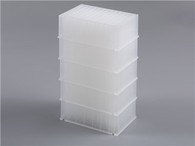





1.2 ml deep well plate
High capacity: With a volume of 1.2 ml per well, this deep-well plate provides a larger sample processing and storage capacity than traditional 96-well plates. This design greatly improves the flexibility and efficiency of laboratories in handling and storing samples. 1.2 ml deep-well plates are particularly important for experiments that require processing larger volumes of samples, such as cell culture, chemical synthesis, and sample concentration. In cell culture experiments, deep-well plates can provide sufficient growth space and nutrient supply to ensure that cells grow and reproduce under optimal conditions. For chemical synthesis experiments, large-capacity wells can accommodate more reactants and reagents, improving reaction efficiency and yield. In addition, during sample concentration, the large-capacity design of deep-well plates allows larger volumes of solutions to be evaporated and concentrated, significantly reducing experimental steps and time.
This deep-well plate is not only suitable for manual operation in the laboratory, but also compatible with high-throughput automated equipment. Automated equipment can precisely control the liquid handling process of each well through programming to ensure sample uniformity and consistency. The high-capacity design of deep-well plates also gives it a unique advantage in high-throughput screening experiments. Researchers can process multiple samples simultaneously in one experiment, greatly improving experimental efficiency and data output.
Strong tolerance: Polypropylene also has good tolerance to extreme temperatures. It can maintain the stability of physical structure and performance under high temperatures (such as high pressure sterilization conditions at 121°C) and low temperatures (such as freezing conditions at -80°C). This wide temperature adaptability allows deep-well plates to be used in a variety of operations such as centrifugation, freezing and heating without deformation or cracking. Especially in biological experiments that require high-temperature disinfection, polypropylene deep-well plates can effectively prevent contamination and ensure the sterility of the experiment.
Physical stability: The physical stability of polypropylene also provides reliable guarantee for the application of deep-well plates. It has excellent mechanical strength and impact resistance. During centrifugation, even at high speeds, it can maintain structural integrity and prevent sample leakage or contamination. In addition, polypropylene material has low hygroscopicity, which can prevent samples from getting damp and deteriorating, which is very important for long-term storage of samples.
High transparency: The high transparency of polypropylene deep-well plates is also a major advantage. This transparency not only facilitates experimenters to directly observe and detect samples, but also allows accurate measurements through optical detection equipment, further improving the accuracy and efficiency of experiments. The non-toxicity and biocompatibility of polypropylene materials ensure its wide application in the biomedical and pharmaceutical fields without adversely affecting cells and biomolecules.
Material characteristics and advantages of this product

This product is usually made of high-purity polypropylene (PP) material. As a high-performance synthetic resin, polypropylene is widely used in various laboratory consumables due to its excellent physical and chemical properties. First of all, polypropylene has excellent chemical resistance and can withstand a variety of common chemical reagents and solvents, including strong acids, strong bases and organic solvents. This chemical resistance allows deep-well plates to maintain high stability and reliability in various biochemical experiments, and will not react with reagents, thereby avoiding interference with experimental results. Whether it is cell culture, enzyme reaction or high-throughput screening, polypropylene deep-well plates can provide researchers with a safe and pollution-free experimental environment.
In addition, polypropylene material also has good mechanical strength and toughness, ensuring the durability and stability of deep-well plates during use. Its low adsorption means that the sample will not be adsorbed by the material during the experiment, thereby maximizing the sample recovery rate and the accuracy of the experiment. Polypropylene also has good transparency, which is convenient for observing the sample status and experimental progress. These excellent properties make polypropylene deep well plates the preferred material for many laboratories, which not only improves the reliability of experiments, but also provides researchers with more convenient and efficient working tools.

In what fields can this deep well plate be applied?
Biotechnology
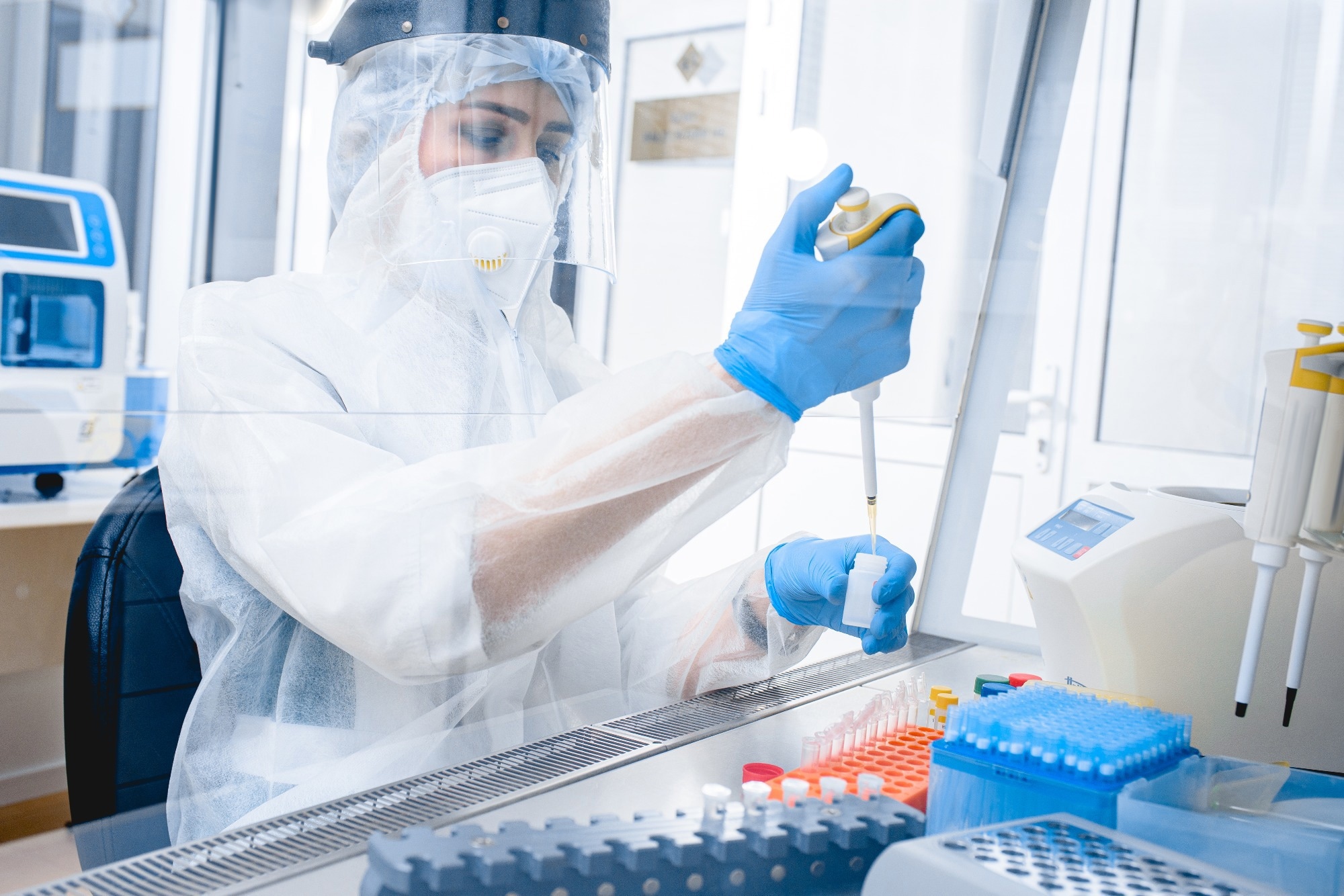
This deep-well plate plays a vital role in the field of biotechnology and is widely used in cell culture, genomics experiments, and high-throughput screening. Its large-capacity design allows researchers to process larger volumes of cell suspension in each well, providing ample space for cell growth, division, and metabolism. This feature is particularly suitable for experiments that require high-density cell culture, such as drug screening or gene expression studies, allowing researchers to obtain more data in one experiment.
In cell culture, the design of the deep-well plate also allows for better control of the culture environment. It can accommodate more culture medium, which is particularly important for long-term experiments because it can effectively reduce the evaporation of culture medium and maintain the stability of culture conditions. In addition, the structure of the deep-well plate also helps to reduce the risk of sample contamination and ensure the reliability of the experiment.
In genomic experiments, this deep-well plate is also an indispensable tool. Researchers often use deep-well plates for DNA and RNA extraction. The capacity of this plate makes it possible to process multiple samples at the same time, improving experimental efficiency. Its design ensures the integrity of the sample and reduces the loss or cross-contamination that may occur during extraction and transfer.
Environmental Science
In environmental science research, this deep-well plate is widely used to analyze pollutants in water, soil, and air samples. The large sample capacity of this deep-well plate provides researchers with more experimental flexibility, allowing them to handle more complex and diverse samples. By using this deep-well plate, researchers can effectively monitor chemical and microbial contamination in the environment, especially when conducting a comprehensive assessment of water and soil contamination. This large capacity design is particularly important.
For example, in water quality testing, researchers can use deep-well plates to simultaneously analyze multiple pollutants, from heavy metals to organic pollutants, to ensure accurate test results. In soil sample analysis, deep-well plates can accommodate more sample volume, providing more reliable data when evaluating pesticides, heavy metals, and other pollutants in soil.
In addition, deep-well plates also play an important role in ecotoxicology research. By simulating the effects of different chemicals on organisms in deep-well plates, researchers can evaluate the toxicity and ecological risks of these substances. This method can not only help identify potential environmental hazards, but also provide a scientific basis for the formulation of effective environmental protection measures.
The good chemical compatibility of the deep-well plate enables it to withstand corrosion from various environmental samples and analytical reagents, ensuring the reliability of the experiment. Whether in the laboratory or in the field, this deep-well plate provides strong support for environmental science research, helping scientists to gain a deeper understanding of the impact of human activities on the ecosystem, thereby promoting environmental protection and sustainable development. Through these applications, this deep-well plate has not only become a key tool for environmental monitoring, but also provided researchers with a more effective and accurate experimental method for environmental science exploration.
Maybe you have the following questions
1: What is the material of this deep well plate?
This deep well plate is usually made of high-purity polypropylene (PP) material. Polypropylene has excellent chemical resistance and physical stability, and can withstand a variety of chemical reagents and solvents while maintaining structural integrity in high and low temperature environments. This makes deep well plates very reliable in biotechnology and chemical analysis.
2: How high a temperature can this deep well plate withstand?
The temperature range that polypropylene deep well plates can withstand is quite wide, and they can generally be used under conditions of -80°C to 121°C. This means that it is suitable for frozen storage of samples and sterilization under high temperature sterilization conditions to ensure experimental stability in extreme environments.
3: The capacity of each well is 1.2 ml. What benefits does this bring to the experiment?
The capacity of 1.2 ml allows each well to handle a relatively large sample volume, which is particularly important for experiments such as cell culture, chemical synthesis, and sample concentration. The larger capacity allows researchers to perform more tests in one experiment, reduce the number of experiments, and thus improve efficiency and data reliability.
4: Is this deep well plate suitable for high-throughput screening experiments?
Yes, this deep-well plate is very suitable for high-throughput screening experiments. Its design allows researchers to process multiple samples at the same time for drug screening and gene function research. This high-efficiency processing capacity allows researchers to obtain more data in a short time and speed up the experimental process.
5: What is the service life of this deep-well plate?
Due to the use of high-purity polypropylene material, this deep-well plate has a long service life. Its good chemical resistance and physical stability mean that it is not easy to deform or break under normal use conditions, and it can be used repeatedly in multiple experiments without affecting performance.
6: How to avoid cross-contamination of samples in deep-well plates?
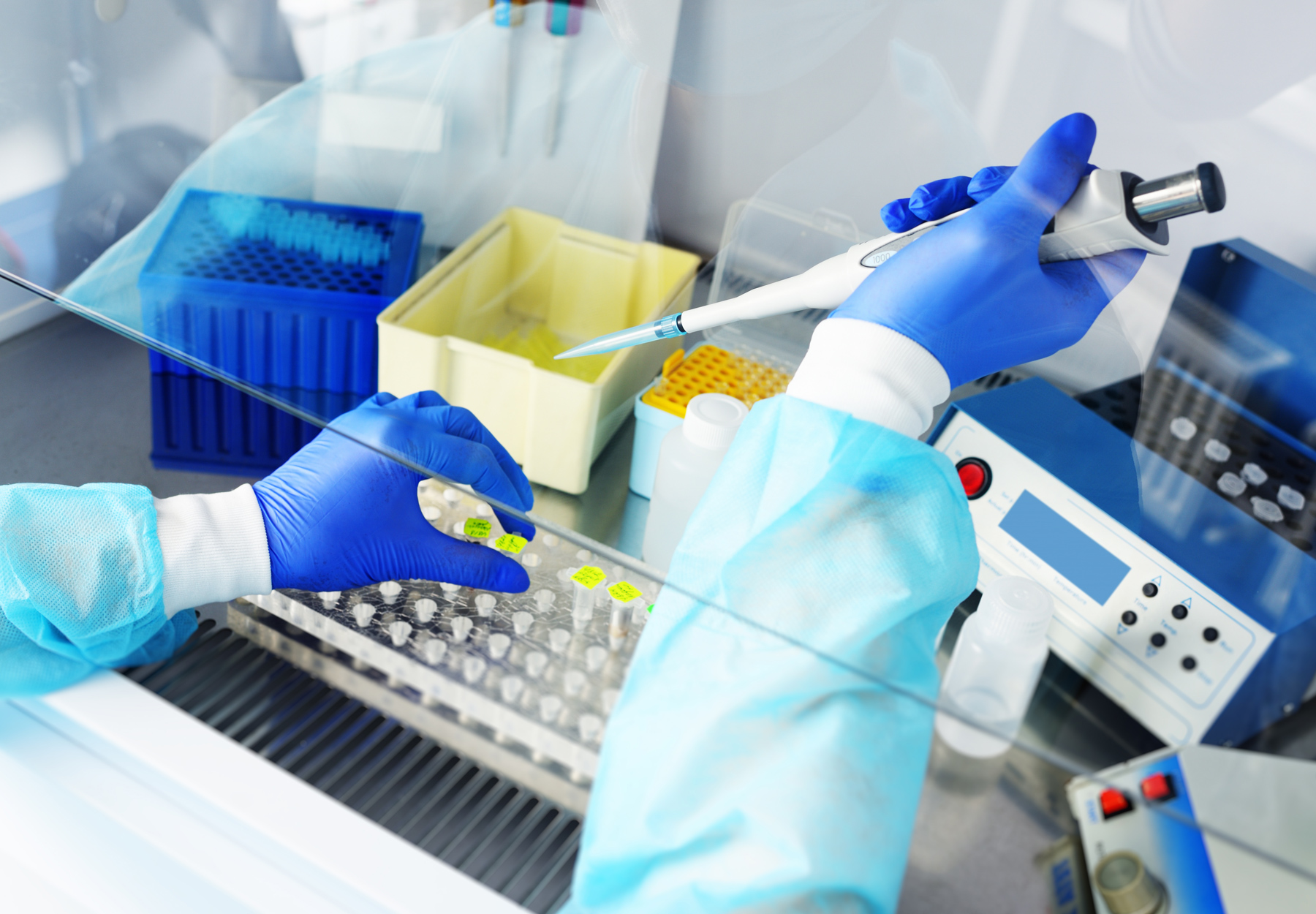
To avoid cross-contamination, it is recommended to follow good laboratory operating practices when using deep-well plates, such as using disposable pipettes and appropriate sample handling equipment. In addition, the design of deep-well plates itself helps to reduce the risk of cross-contamination, because its large well capacity can reduce the time and opportunity for samples to be exposed to the external environment.
7: Is this deep-well plate compatible with automated equipment?
Yes, this deep-well plate is compatible with many automated equipment and is very suitable for high-throughput experiments. Researchers can use automated liquid handling systems to perform precise sample transfer and liquid dispensing, thereby improving the accuracy and efficiency of experiments. This compatibility makes it easier for laboratories to conduct high-throughput screening and other complex experiments.
Hot Tags: 1.2 ml deep well plate, China, suppliers, manufacturers, factory, custom, wholesale, for sale, Lab Plastic Pcr Tubes, Hard Shell 96 Well Pcr Plate, Deep Well Plate, Pcr Tubes For Qpcr, Polypropylene Pipette Tip, Filter Pipette Tip