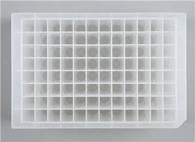





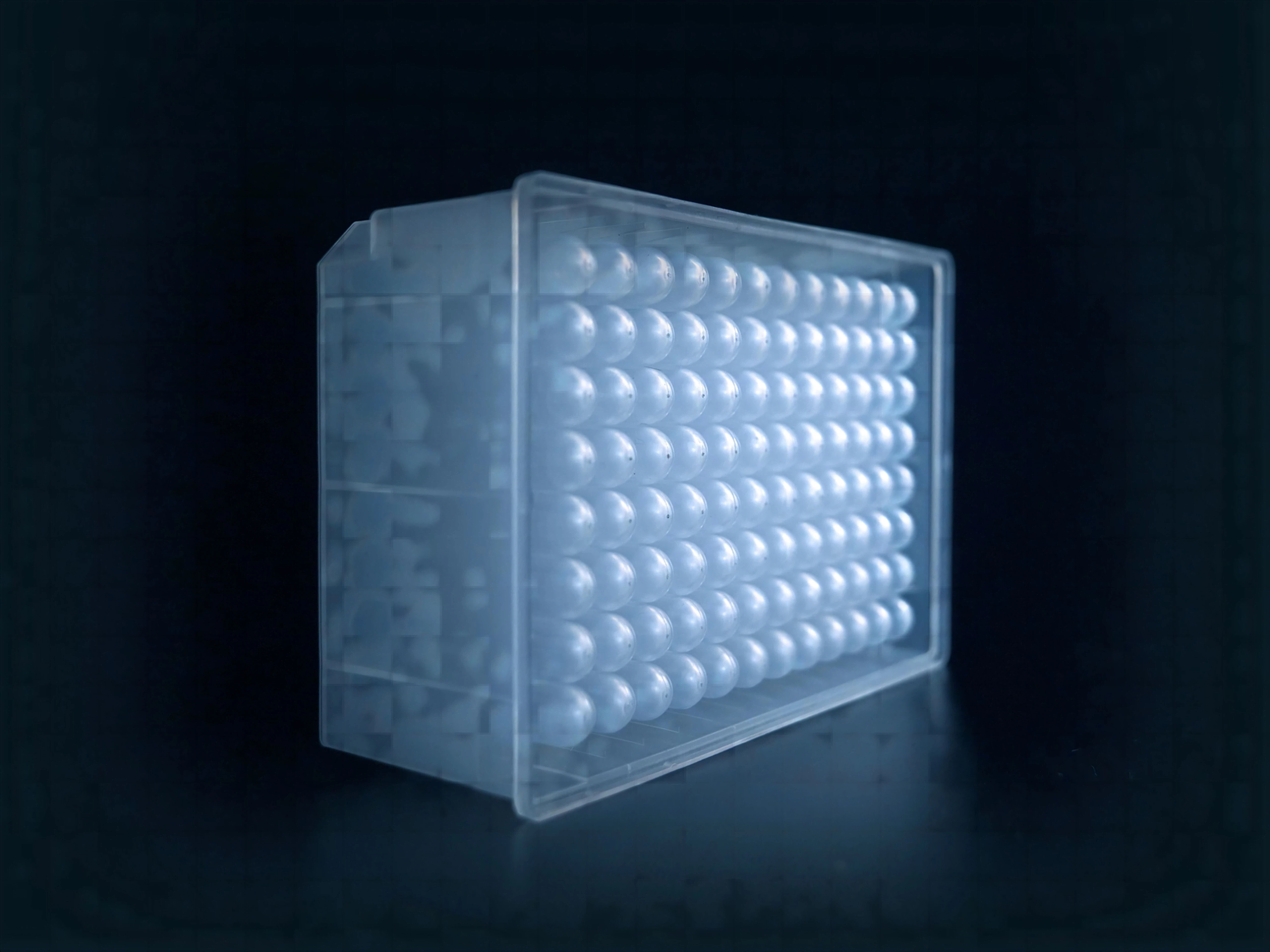
deep well 96 well plates
High-capacity design: Each well of a deep-well 96-well plate typically has a capacity of 1.5 ml to 2.2 ml, which is much larger than a traditional 96-well plate (usually 200 to 300 microliters). This high-capacity design makes it particularly suitable for experiments that require processing larger volumes of samples, such as concentration, separation, and multi-step reactions. Larger sample capacity reduces the need to repeatedly transfer samples during experiments, thereby reducing the risk of sample loss and contamination. This design also allows for more diverse experimental operations on the same plate, improving the overall efficiency of the laboratory.
Material chemical and temperature resistance: Deep-well 96-well plates are usually made of polypropylene (PP), a material that is chemically resistant and has excellent thermal stability. Polypropylene can resist corrosion from most acids, bases, and organic solvents, making the product suitable for a variety of chemical reactions and sample processing processes. In addition, the high-temperature resistance of polypropylene allows the product to be used in an autoclave environment at 121°C and can also be frozen and stored at conditions as low as -80°C. This wide temperature adaptability ensures the stability and safety of samples under various experimental conditions.
Automation compatibility: The design of the deep-well 96-well plate complies with the SBS (Society for Biomolecular Screening) standard, which makes it compatible with a variety of automated equipment, including automatic pipettes, liquid handling workstations, and high-throughput screening equipment. The standardized design ensures that automated equipment can accurately handle samples in high-throughput experiments, improving experimental repeatability and data consistency. This compatibility is particularly important for modern laboratories, especially in drug screening and genomics research, where high-throughput screening technology relies on such standardized consumables to ensure efficiency and precision.
Prevent cross-contamination: In order to prevent cross-contamination between samples, deep-well 96-well plates are usually designed with anti-overflow edges. This design effectively prevents liquid from overflowing into adjacent wells during operation. In addition, the surface of the plate is specially treated to make it smooth and low-adsorbent, reducing the residue of samples on the well wall. By reducing residues, the risk of cross-contamination between samples is reduced, especially in biochemical and molecular biology experiments that require high precision, this design can ensure the accuracy and reliability of experimental results.
Main material features of this product
Deep Well 96 Well Plates are mainly made of polypropylene. Here are the main features of this material:
Excellent chemical resistance
Polypropylene has excellent chemical resistance. This material can effectively resist the erosion of most acids, bases, salts and organic solvents, allowing deep-well 96-well plates to remain stable in various chemical reactions and treatments. Whether it is used for high-concentration acidic or alkaline solutions or for processing complex organic compounds, the chemical stability of polypropylene ensures the safety of samples and the accuracy of experiments.

High and low temperature resistance
Polypropylene has a high melting point, generally between 160°C and 170°C, so it can maintain structural stability under high temperature conditions. This allows deep-well 96-well plates to withstand high-temperature sterilization (121°C) without deformation, ensuring the sterility of experimental equipment and reliable handling of samples. In addition, polypropylene also shows good stability in low-temperature environments and can be safely used under freezing conditions of -80°C, suitable for frozen preservation and long-term storage of samples.
Application areas of deep well 96 well plates

Biochemical analysis
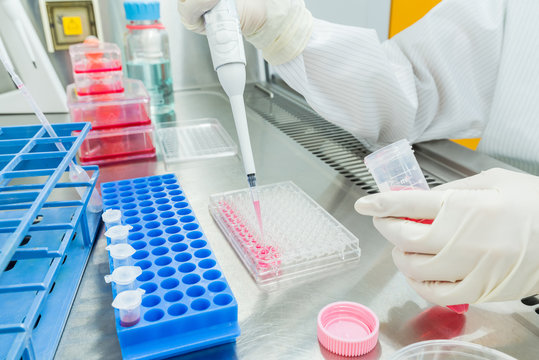
Protein analysis: In the study of protein quantification, enzyme activity determination, and protein-protein or protein-small molecule interactions, deep-well 96-well plates provide a large-capacity reaction space, suitable for processing various complex biochemical samples.
ELISA detection: Enzyme-linked immunosorbent assay (ELISA) requires high-throughput sample processing. Deep-well 96-well plates can support the detection of a large number of samples, improving the efficiency of the experiment and the reliability of the data.
Cell culture and research
Cell bank establishment and storage: In cell biology research, deep-well 96-well plates are used to establish cell banks and store cell samples for a long time. Its large-capacity design is suitable for culturing multiple cell lines at the same time, and can effectively manage and maintain the stability of cells.
Cytotoxicity test: For cytotoxicity testing of drugs or chemicals, deep-well 96-well plates can simultaneously evaluate the effects of multiple samples on cells, providing data support for drug safety evaluation.
Maybe you have the following questions
1. What is the main material of this plate?
This plate is mainly made of polypropylene (PP). The advantage of polypropylene is its excellent chemical resistance, which can resist a variety of acids, alkalis and organic solvents, so it performs well when handling corrosive chemicals. In addition, polypropylene's high temperature resistance makes it suitable for high temperature sterilization, while its low temperature resistance supports frozen storage. The low adsorption of polypropylene also reduces the risk of sample residue and cross contamination, and improves the accuracy of experimental results.
2. What is the well capacity of this plate?
The capacity of each well is usually between 1.5 ml and 2.2 ml. This large-capacity design makes it particularly suitable for experiments that require processing larger volumes of samples, such as concentration and separation experiments. It also allows more reaction steps to be performed in a single well, reducing the number of sample transfers, thereby reducing the risk of operational errors and sample loss. The large-capacity design enables more samples to be processed when performing high-throughput screening and analysis, greatly improving experimental efficiency.
3. How does this product adapt to automated equipment?
The plate is designed to meet the SBS (Society for Biomolecular Screening) standard, which ensures its compatibility with various automated equipment, including automatic pipettes and liquid handling workstations. The standardized well spacing and layout enable automated equipment to accurately handle and analyze samples, suitable for high-throughput screening and experiments. Such compatibility significantly improves the efficiency of experiments and the consistency of data, especially in experiments that require a large number of samples to be processed simultaneously.
4. How to ensure that the plate avoids cross-contamination in experiments?
This plate has an anti-overflow edge design to prevent liquid from overflowing into adjacent wells during operation. In addition, its surface is treated with low adsorption, which reduces the residue of samples on the well wall. These design features effectively reduce the risk of cross-contamination and ensure the reliability of experimental results, especially in experiments that require high precision and high repeatability.
5. Can this plate adapt to extreme temperature conditions?
Yes, this plate can be used in a wide temperature range from -80°C to 121°C. It can withstand low-temperature freezing and can also withstand high-temperature sterilization processes. This wide temperature adaptability makes the plate suitable for a variety of experimental conditions, from long-term storage to high-temperature processing, ensuring sample stability and experimental consistency.
6. What are the advantages of this plate in high-throughput screening and analysis?
High-throughput screening often requires the processing of a large number of samples at the same time, and the large capacity design and compatibility with automated equipment of this plate provide significant advantages. The large capacity allows more samples to be processed per well, reducing the number of experimental plates required. Strong compatibility with automated equipment makes sample processing more efficient and reduces the need for manual operation, thereby improving data accuracy and experimental repeatability.
7. Has this product been verified in actual applications?
Yes, this plate has been widely used in experiments in many fields and has performed well in fields such as biology, drug development, environmental monitoring and clinical diagnosis. Its design has been verified by years of use and can provide reliable performance under various experimental conditions. Practical application cases include high-throughput genetic screening, drug screening, cell culture and microbial analysis, which fully demonstrates its value in high-efficiency and high-precision experiments.
Hot Tags: deep well 96 well plates, China, suppliers, manufacturers, factory, custom, wholesale, for sale, 200 L pipette Tip, 96 well Pcr Microplate, Disposable Pp Material Plastic Pcr Tubes, U Bottom 96 Deep Well Plate, 300 L Pipette Tip, Disposable Pipette Tip