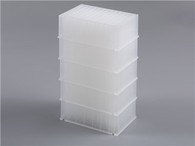





2 ml deep well plates
Large volume capacity
The 2 ml capacity of each well enables deep-well plates to handle larger volumes of samples, especially for experiments that require large volumes of liquid. The large capacity not only accommodates more reagents and samples, but also allows for concentration gradient experiments, long reactions, and long-term storage of samples. This feature optimizes the experimental operation process, improving experimental efficiency and data accuracy by reducing the need for sample transfer and repeated operations. For experiments that require multiple steps in a single well, such as enzyme-linked reactions or mixed reactions, this large-capacity design provides sufficient space and flexibility.
Excellent chemical stability
The deep-well plate is made of high-quality polypropylene (PP) material with excellent chemical stability. Polypropylene shows excellent tolerance to most common chemicals, solvents, and reagents, and can maintain its physical and chemical properties under a variety of complex experimental conditions. This chemical resistance ensures that the plate will not degrade or be damaged when handling strong acids, strong bases, and organic solvents, thereby maintaining the reliability of the experiment and the accuracy of the results. Its chemical stability also ensures that the material will not deteriorate during long-term use, reducing interference during the experiment.
Wide temperature adaptability
This deep well plate can be used in a wide temperature range of -80°C to 121°C. This excellent temperature adaptability enables it to meet a variety of experimental needs from frozen storage to high temperature sterilization. Under frozen conditions, samples can be stored for a long time without affecting the performance of the plate; under high temperature conditions, the plate can still maintain structural integrity and is suitable for high temperature sterilization and other heat treatment processes. Whether the experiment requires low temperature storage or high temperature treatment, this temperature adaptability ensures the stability and reliability of the experiment.
Anti-evaporation design
In order to prevent the sample from evaporating during long-term storage or processing, this deep well plate is designed with an effective anti-evaporation function. This design reduces the evaporation loss of the liquid by optimizing the well plate structure and surface treatment. Especially in experiments that require long-term observation or reaction, this feature can effectively maintain the stability of the sample volume and prevent concentration changes caused by evaporation, thereby ensuring the accuracy and repeatability of the experimental results. The anti-evaporation design is particularly important for precision analysis and long-term experiments, and can maintain the original properties and concentration of the sample during the experiment.
Main material features of this product
2 ml deep well plates are mainly made of polypropylene. Here are the main features of this material:
Low adsorption
Low adsorption
Polypropylene's low adsorption properties are a key advantage. The surface of this material is finely processed, making it smooth and virtually non-adsorbent to samples or reagents. Low adsorption directly affects the accuracy and reliability of experiments because it reduces sample residue on the well walls. Such properties are particularly important when working with high-value or difficult-to-recycle samples. By reducing sample carryover, polypropylene deep well plates help maximize sample recovery, thereby improving the economics and efficiency of your experiments.
In addition, low adsorption properties significantly reduce the risk of cross-contamination. During the experiment, especially when multiple samples and reagents are involved, sample residues on the well walls may lead to cross-contamination and affect the accuracy of experimental results. The smooth surface of polypropylene reduces this risk, ensuring independence between different samples and maintaining data authenticity and consistency. This is particularly critical for experiments that require high precision and reproducibility, such as drug screening, nucleic acid extraction, and enzyme-linked immunosorbent assays. Low adsorption plays an important role in these applications.


High transparency and visibility
Although deep-well plates are primarily used for liquid sample processing, some versions of polypropylene plates offer higher transparency, which provides additional convenience for experimental operations. High transparency allows users to clearly view the sample and liquid status within the wells when necessary. This visibility is useful when conducting visual inspections or observing sample changes, especially when rapid assessment of liquid volume or color changes is required during sample processing.
Although the impact of transparency may not be as pronounced in deep-well plates as in thin-walled plates, transparency still provides additional convenience in certain applications, such as when it is necessary to observe sample sedimentation, bubble formation, or liquid stratification. The transparent polypropylene sheet allows users to monitor the experimental process more intuitively and adjust experimental conditions or processing steps in a timely manner to optimize experimental results and data quality.
Application of this product on (HTS) samples
Large capacity supports high-throughput operation
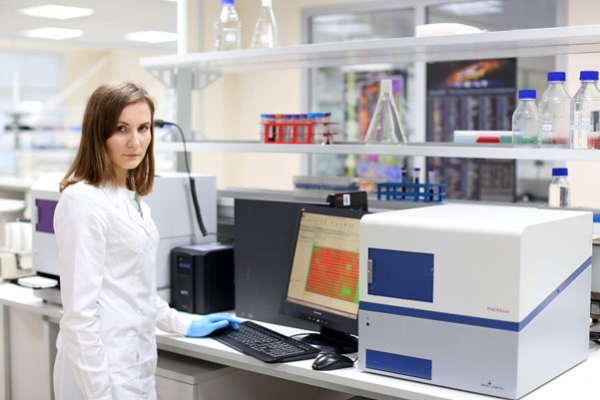
The 2 ml capacity of each well enables deep-well plates to accommodate larger sample volumes, which is particularly important for processing large numbers of samples in high-throughput screening. In HTS, multiple samples usually need to be processed and analyzed simultaneously. The 2 ml well capacity allows multi-step reactions or concentrations to be performed in a single well, reducing the number of plates required for the experiment. This large-capacity design can meet the needs of high-throughput screening, thereby improving experimental efficiency and the speed of data acquisition.
Compatible with automated equipment
This deep-well plate conforms to the SBS (Society for Biomolecular Screening) standard well spacing design, making it highly compatible with a variety of automated equipment. Automatic pipettes, liquid handling workstations, and high-throughput screening systems are often used in high-throughput screening processes. These automated equipment can accurately handle, distribute, and analyze samples. The standardized well spacing and layout ensure seamless docking with automated equipment, improve the level of automation in experiments, and reduce the need for manual operations, thereby accelerating the speed of sample processing and the accuracy of data.
Maybe you have the following questions
1: What is the material of this product?
This product is mainly made of polypropylene (PP), a high-quality plastic with excellent chemical stability and temperature adaptability. Polypropylene can resist a variety of chemical reagents and solvents, while being stable in a wide temperature range of -80°C to 121°C. This material ensures reliability and stability under different experimental conditions, and has excellent durability for long-term use.
2: What is the capacity of each well?
The capacity of each well is 2 ml. This design enables the product to handle and store larger volumes of samples, which is very suitable for experiments that require concentration, separation or processing of larger volumes of liquid. This high-capacity design provides great convenience in high-throughput screening and other experiments that require large volumes of samples.
3: How does this product support automated operations?
The well spacing and layout of this product meet the SBS (Society for Biomolecular Screening) standard, which makes it compatible with a variety of automated equipment such as automatic pipettes and liquid handling systems. The standardized design ensures that automated equipment can handle samples accurately, thereby improving the efficiency of high-throughput experiments, reducing the need for manual operations, and optimizing the experimental process.
4: Is this product suitable for low-temperature storage?
Yes, the product can be used stably at a low temperature of -80°C. The excellent low-temperature resistance of its material makes it suitable for frozen storage of samples, ensuring that the samples will not be damaged by embrittlement or cracking of the material at extremely low temperatures. This feature makes it perform well in experiments that require long-term low-temperature storage of samples.
5: How is the surface treatment of this product?
The surface of this product is finely treated and has low adsorption. The smooth surface reduces the adhesion of samples and reagents on the well wall, thereby reducing the risk of cross-contamination and improving the recovery rate of samples. Low adsorption not only ensures the accuracy of the experiment, but also reduces the loss of samples, which is especially suitable for experiments requiring high precision and high repeatability.
6: Can this product remain stable under high temperature conditions?
Yes, the product can be used stably in high temperature environments up to 121°C. Its material has excellent high temperature resistance, making it suitable for high temperature sterilization. Whether it is heat treatment or high temperature operation, the product can maintain its structural integrity and performance, ensuring stability during the experiment.
7: What types of experiments are this product suitable for?
This product is widely used in multiple experimental fields, including drug screening, cell culture, nucleic acid extraction, enzyme reactions, and high-throughput screening. Its high-capacity design, automation compatibility and durability make it excellent in processing large numbers of samples, performing multi-step reactions and sample storage. Especially in experiments that require efficient processing and analysis of large numbers of samples, this product provides an ideal solution.
Hot Tags: 2 ml deep well plates, China, suppliers, manufacturers, factory, custom, wholesale, for sale, 2 2ml 96 deep well plate, Tip Comb, Plastic Universal Tip, Polypropylene Pcr Microplate, Disposable Pipette Tip, Lab Plastic Pcr Tubes