


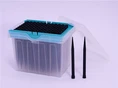





Deep-well plate, V-bottom
V-bottom design
The V-bottom design is a major feature of deep-well plates. It optimizes the liquid handling and sample analysis process through a unique geometric structure. This design allows the liquid to form a concentrated area at the bottom of the well, ensuring that the sample can be effectively collected in each experiment and reducing the problem of liquid residue. This is particularly important for many experimental operations, especially those involving centrifugation, separation, and sampling.
During the centrifugation process, solid particles or cells in the sample usually settle to the bottom of the liquid. The shape of the V-bottom helps these sediments to concentrate at the bottom faster and form a tight pile. This not only improves the separation efficiency of the sample, but also makes sampling easier and more accurate when performing subsequent operations.
In addition, the V-bottom design also optimizes the sampling process. When performing multiple sample analyses, researchers need to ensure that a uniform liquid sample is extracted from each well. The concentrated liquid area provided by the V-bottom makes the operation of the pipette more convenient, which can minimize errors and improve the reliability of experimental results.
This design also allows the liquid to be evenly distributed during heating or cooling, ensuring that the sample can maintain a consistent temperature and concentration when performing chemical or biological reactions. This is particularly important for many biological experiments that require precise control of experimental conditions, such as PCR reactions or cell culture.
Advantages of deep-well structure
The deep-well plate, with its unique deep-well structure design, provides important technical advantages for laboratories and scientific research. This design not only expands the sample volume, but also enhances the flexibility and efficiency of experimental operations.
The primary advantage of the deep-well structure is that it provides a larger volume space. The depth and diameter of each well are designed to be wide enough to accommodate a large amount of liquid samples. This feature makes deep-well plates particularly important in experiments that require large-volume reactions or multiple sampling. For example, in high-throughput screening or large-scale production, researchers often need to process a large number of samples for simultaneous reactions or analysis, and deep-well plates can meet this need, ensuring that each well can accommodate enough reagents or samples.
In addition to the increase in capacity, the deep-well structure also helps reduce the risk of liquid overflow. The deep-well design allows the liquid to be stably distributed in each well, avoiding confusion and waste caused by too much sample. This stability not only makes experimental operations safer, but also improves the accuracy and repeatability of sample processing, especially when precise analysis and experimental result verification are required.
In addition, the deep-well structure also provides support for automation and high-throughput operations during the experiment. This design enables deep-well plates to be integrated with automated equipment and robotic systems to achieve more efficient sample processing and data collection. In modern laboratories, high-throughput screening and analysis have become common requirements for scientific research, and deep-well plates have become an ideal choice to meet these needs through their large capacity and convenient operation.
Features and advantages of deep-well plate materials

Polystyrene (PS)
Polystyrene is a common synthetic resin that is widely used in laboratory equipment due to its excellent transparency and formability. When deep-well plates are made of polystyrene material, they have the following advantages:
Excellent optical properties: Polystyrene has high transparency and can clearly observe the state of the sample in the well, especially in experiments that require optical detection. This is especially important for cell observation or reaction monitoring.
Strong adaptability: PS materials are compatible with a variety of common chemical reagents, such as buffer solutions, saline solutions, etc., and are suitable for a wide range of biological and chemical experiments.
Economical: Polystyrene has a lower cost than other materials, making deep-well plates more economical when used on a large scale and suitable for high-throughput screening needs.
Polypropylene (PP)
Polypropylene is another material commonly used in deep-well plates. It is widely used in scientific research for its unique properties:
Chemical resistance: Polypropylene has good corrosion resistance to a variety of acids, bases and organic solvents, which makes it perform well when handling corrosive samples and reduces the risk of material damage.
Temperature stability: PP materials can also maintain stability at higher temperatures and are suitable for high-temperature sterilization or heating experimental conditions, which is particularly important for biological samples and chemical reactions.
UV resistance: Some polypropylene deep-well plates have UV protection, which can protect light-sensitive samples from UV damage. This is crucial for storing and handling light-sensitive compounds or biological materials to ensure the accuracy and reliability of experimental results.

In what fields can deep well plate v bottom be applied?

Cell culture
Provide a suitable growth environment
The deep well design of the deep well plate allows cells to have enough space to grow in each well. Compared with shallow well plates, deep well plates can accommodate more culture medium, which provides cells with abundant nutrients and oxygen, promoting their rapid growth and reproduction. In addition, the structure of the deep well reduces the possibility of culture medium evaporation, maintains the stability of the culture environment, and ensures the activity and health of cells throughout the culture process.
Easy to handle multiple samples
In cell biology research, it is often necessary to process multiple samples at the same time for comparative experiments. The design of the deep well plate allows researchers to culture multiple different types of cells or different treatment groups of the same cells in one plate. This high-throughput feature makes experiments more efficient and saves time and resources. At the same time, deep well plates are usually compatible with automated equipment, which facilitates high-throughput screening and data acquisition.
Drug Screening
Advantages of High-Throughput Screening
Screening potential drug candidates is a key step in the drug development process. Traditional methods often require testing samples one by one, which is time-consuming and labor-intensive. The high-throughput characteristics of deep-well plates allow researchers to test dozens to hundreds of samples simultaneously in the same experiment. Each well can independently process different compounds and quickly evaluate their effects on specific targets or cell lines, which greatly improves the efficiency of the experiment.
Easy to conduct parallel experiments
The design of deep-well plates is very suitable for parallel experiments. Researchers can set up multiple drugs of different concentrations in one plate to observe their effects on cell growth, metabolism or other biological responses. This parallelism makes data collection more systematic and provides a rich information basis for subsequent data analysis. In addition, deep-well plates are usually compatible with automated systems, enabling rapid sample transfer and data recording, further improving the automation of experiments.

Maybe you have the following questions
1. What are the advantages of the V-bottom design of deep-well plates?
The V-bottom design allows liquids to gather effectively at the bottom of the well, which helps to completely collect and analyze samples. During centrifugation, separation, and sampling, the V-bottom can speed up the precipitation process and ensure that the sample is concentrated at the bottom, thereby improving the efficiency and accuracy of the experiment.
2. What materials are deep-well plates usually made of?
Deep-well plates are generally made of non-toxic, chemically resistant materials such as polystyrene (PS) and polypropylene (PP). These materials are compatible with a variety of reagents to ensure that no harmful reactions occur during chemical and biological experiments. At the same time, some models of deep-well plates also have UV protection properties, which are suitable for storing light-sensitive samples.
3. What types of experiments are deep-well plates suitable for?
Deep-well plates are widely used in many fields such as cell culture, molecular biology experiments, drug screening, and toxicity testing. In cell culture, it can provide a suitable growth environment for cells; in molecular biology experiments, it can be used for operations such as PCR and fluorescence detection; in drug screening, deep-well plates can efficiently process multiple samples and improve experimental efficiency.
4. How to clean and maintain deep-well plates?
When cleaning deep-well plates, it is recommended to use mild detergents and clean water, and avoid using strong acid and alkaline chemicals. For reusable deep-well plates, especially after cell culture, be sure to disinfect thoroughly to prevent cross-contamination. After cleaning, make sure it is completely dry to avoid bacterial growth.
5. What temperatures can deep-well plates withstand?
Deep-well plates made of different materials have different tolerances to temperature. Polypropylene deep-well plates can generally withstand higher temperatures and are suitable for high-temperature sterilization, while polystyrene is not suitable for use at high temperatures. Therefore, when designing experiments, appropriate materials should be selected according to specific experimental conditions.
6. How are deep-well plates compatible with automated equipment?
Deep-well plates are usually designed with compatibility with micropipettes and automated equipment in mind, ensuring that researchers can quickly and accurately transfer and process samples. This compatibility makes deep-well plates ideal for high-throughput screening and automated experiments, improving experimental efficiency and reducing human errors.
7. What should I pay attention to when using deep-well plates?
When using deep-well plates, researchers should pay attention to the following points:
Make sure to choose the right materials and specifications to meet the specific needs of the experiment.
When handling chemicals, wear appropriate personal protective equipment to ensure safety.
During the experiment, ensure that the deep-well plate is placed stably to avoid liquid spillage or contamination.
Record the sample information of each well to ensure the accuracy and traceability of the data.
Hot Tags: deep well plate v bottom, China, suppliers, manufacturers, factory, custom, wholesale, for sale, Sterile Filter Tip, 96 Well Deep Well Plate, Clear Pcr Microplate, Pcr Microplate, Deep Well Plate, 1000 l Universal Pipette Tip


