


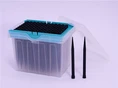





Using a 96-tip comb for deep well applications offers several advantages:
Increased Throughput: With 96 tips, the comb allows for simultaneous loading or sampling of multiple wells. This significantly increases the throughput compared to single-tip combs, where each well would need to be addressed individually.
Time Efficiency: Loading or sampling multiple wells simultaneously saves time, making experiments or assays more efficient. This is particularly beneficial in high-throughput screening scenarios where large numbers of samples need to be processed quickly.
Reduced Variability: The use of a multi-tip comb ensures consistent and uniform loading or sampling across wells. This reduces variability between samples, leading to more reliable experimental results.
Conservation of Samples: By loading or sampling multiple wells at once, the amount of sample needed for the experiment is reduced compared to single-tip methods. This conservation of samples can be crucial, especially when working with limited or precious samples.
Ease of Handling: Handling a single comb with 96 tips is often more convenient than using multiple single-tip combs. It reduces the risk of errors associated with transferring samples between different combs and simplifies the experimental workflow.
Compatibility with Automation: Many deep well plates are designed to be compatible with automation systems. Using a 96-tip comb aligns well with automation protocols, further enhancing throughput and minimizing human intervention.
Cost Efficiency: While the initial cost of a 96-tip comb may be higher than that of single-tip combs, the overall cost per sample processed is lower due to increased throughput and reduced sample consumption.
Versatility: A 96-tip comb can be used for various applications such as sample loading, gel loading, or sample transfer, making it a versatile tool in molecular biology and biochemical research.
In conclusion, the use of a 96-tip comb for deep well applications offers significant advantages in terms of throughput, time efficiency, sample conservation, reliability, and cost-effectiveness, making it a preferred choice for many laboratory workflows.