







96-well polypropylene deep-well plates
Large capacity design
The capacity of each well is 2.2 ml. Compared with traditional microplates, this large-capacity design provides more sufficient storage space for the laboratory. This property makes it particularly suitable for handling experiments requiring large amounts of samples, such as high-throughput screening and drug development. Such experiments often involve thousands of samples, and the capacity of traditional microplates often cannot meet the demand. Therefore, using a large-capacity design can effectively reduce the steps of sample aliquots and significantly improve the overall efficiency of the experiment. At the same time, the large-capacity design also supports multiple reactions and long-term storage, ensuring that samples will not be lost due to insufficient volume during storage, thereby further improving the reliability and results of experiments.
High temperature tolerance
This product has excellent high temperature resistance and can be used repeatedly in high-pressure steam sterilizers without deformation or performance degradation. This feature is crucial for experiments in laboratories that require a sterile environment, as it ensures effective sterilization of samples at high temperatures and prevents the growth of bacteria and contaminants. This high temperature tolerance allows researchers to perform complex experimental operations under sterile conditions and ensure the accuracy of experimental results. In addition, the material design with high temperature resistance also reduces the frequency of replacement of consumables in the laboratory, further improves the economy and efficiency of experiments, and provides a more stable and reliable guarantee for scientific research work.
Standardized size design
The 96-well deep well plate follows the SBS (Society for Biomolecular Screening) international standard to ensure its compatibility with most automated equipment, liquid handling systems and robots. This standardized design greatly facilitates the conduct of high-throughput experiments, allowing researchers to easily integrate it into existing laboratory equipment. The standardized size not only improves the utilization efficiency of laboratory equipment, but also simplifies the experimental operation process. Researchers can quickly replace consumables without recalibrating equipment, thereby effectively improving the efficiency of sample processing and ensuring the consistency and reproducibility of experimental results.
Deep hole design reduces evaporation and pollution
The design of the deep hole structure effectively reduces the evaporation of the sample during the experiment, especially during long-term storage, and can maintain the stability of the sample. This property is particularly important for experiments that require long-term observations or reactions, such as genomics and proteomics studies. In addition, the deep well design reduces contact between samples, significantly reducing the risk of cross-contamination. This not only ensures the integrity of the sample, but also provides guarantee for high-precision experiments. By reducing interactions between samples, researchers can obtain more accurate and reliable experimental results, thereby increasing the success rate and credibility of experiments.
Material composition and features
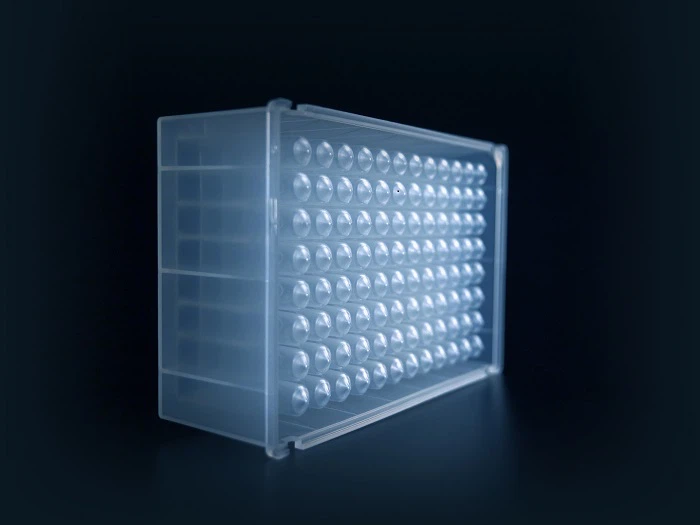
This deep-well plate is made of high-purity polypropylene (PP) material to ensure its excellent performance in a variety of experimental environments. Polypropylene has excellent chemical corrosion resistance and can resist the erosion of strong acids, strong alkalis and various organic solvents, ensuring the safety of samples during the experiment. This chemical resistance not only extends the service life of the deep-well plate, but also reduces the risk of experimental failure due to material degradation. In addition, the non-toxic and low adsorption properties of polypropylene materials enable it to effectively avoid sample contamination and loss when handling trace samples or sensitive substances, thereby ensuring the accuracy and reliability of experimental results. Whether in molecular biology, chemical synthesis or drug development, the superior performance of this material provides researchers with a more reliable experimental basis.
In a laboratory environment, it is crucial to use high-quality materials, which not only affects the stability of experimental results, but is also directly related to the effectiveness of research. The physical properties of polypropylene, such as transparency and good impact resistance, ensure convenience when observing and operating samples. Its high temperature tolerance also allows deep-well plates to be repeatedly used in high-pressure steam sterilizers without deformation or performance degradation, thus providing convenience for high-temperature sterilization. This feature is particularly suitable for experiments that require sterile conditions, ensuring the sterilization of samples and avoiding the growth of bacteria and other contaminants.

Application areas of 96-well polypropylene deep-well plates

Biomedical research
In biomedical research, this kind of deep-well plate is an important experimental tool and is widely used for sample storage and processing. It plays an important role especially in the fields of high-throughput screening, drug discovery, and genomics research. Its large-capacity design (each well has a capacity of 2.2 ml) allows researchers to process a large number of samples simultaneously in the same experiment, significantly improving the efficiency of experiments. Researchers can quickly screen potential drug molecules and biomarkers, accelerating the process of drug development.
In addition, the structural design of deep-well plates optimizes laboratory workflow, especially in cell culture and molecular experiments. By allowing cells to grow and divide in these wells, researchers can achieve more efficient sample management. This design reduces sample loss during transfer, reduces the risk of cross-contamination, and ensures the reliability of experimental results. In addition, because the deep hole design effectively reduces the evaporation of the sample, the experimenter can maintain the stability of the sample during long-term experiments, ensuring the accuracy of the data.
Molecular biology
In the field of molecular biology, this kind of deep-well plate is also widely used, especially in experiments such as PCR reactions, real-time quantitative PCR, gene cloning and protein expression. Its high temperature resistance allows the product to be used multiple times under high temperature sterilization conditions, thereby ensuring the need for a sterile environment and greatly improving the safety and accuracy of experiments. This feature is crucial in molecular experiments because it effectively prevents the introduction of bacteria and other contaminants, ensuring the validity of experimental results.
At the same time, the low adsorption of polypropylene materials minimizes the loss of samples in the pores, which plays a key role in improving the sensitivity and specificity of experimental reactions. When performing real-time quantitative PCR, the accuracy of the sample directly affects the final data results. Therefore, using this deep-well plate can ensure that researchers obtain reliable experimental data. In addition, its design can accommodate various liquid handling equipment, allowing high-throughput experiments to be carried out smoothly, improving the overall efficiency and scientific nature of research. Through these characteristics, deep well plates have demonstrated their indispensable value in all experimental stages of molecular biology.

Maybe you have the following questions
Q1: What is the capacity of this deep-well plate?
Each well has a capacity of 2.2 ml, providing ample space to handle larger samples. This capacity is particularly suitable for high-throughput screening and drug development experiments.
Q2: What is the material of this deep-well plate?
Made of high-purity polypropylene (PP) material, the plate has excellent chemical corrosion resistance and can resist a variety of strong acids, strong bases and organic solvents. This ensures stability and reliability under various experimental conditions.
Q3: Can it be used at high temperatures?
Yes, this product has excellent high-temperature resistance and can be repeatedly used in high-pressure steam sterilizers without deformation or performance degradation. This makes it particularly suitable for experiments that require a sterile environment, such as cell culture and molecular experiments.
Q4: Does this product comply with international standards?
Yes, this deep-well plate follows the SBS (Society for Biomolecular Screening) international standard, ensuring its compatibility with most automated equipment, liquid handling systems and manipulators. This standardized design greatly facilitates high-throughput experiments.
Q5: How to reduce cross-contamination between samples?
The deep-well plate adopts a deep-well design, which effectively reduces the evaporation of samples during the experiment, especially when stored for a long time, and can maintain the stability of the samples. In addition, the deep-well structure also reduces the contact between samples, thereby significantly reducing the risk of cross-contamination and ensuring the accuracy of the experiment.
Question 6: What types of experiments are suitable?
This deep-well plate is suitable for a variety of experimental types, including genomics, proteomics, high-throughput screening, chemical synthesis, and environmental monitoring. Its superior physical and chemical properties enable it to meet the needs of different experiments and improve the efficiency and accuracy of research.
Question 7: Is it easy to clean and disinfect after use?
The surface of the material is smooth, easy to clean and disinfect, and can effectively remove residues and contamination. After high-temperature sterilization, it can ensure the safety and reliability of its repeated use and reduce the cost of consumables in the laboratory.
Hot Tags: 96-well polypropylene deep-well plates, China, suppliers, manufacturers, factory, custom, wholesale, for sale, Sterile Pcr Tubes Strip, plastic PCR Tubes, Filter Pipette Tip, Sterile Pipette Tip, Pcr Microplate, Pcr Tubes


