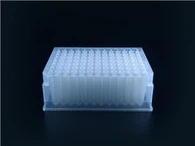





96-well deep well plates
The large-capacity design is a highlight of this experimental consumable. The capacity of each well is up to 2.2 ml, which provides greater storage and processing space compared to traditional 96-well microplates. This large capacity is particularly suitable for use in experiments that require processing a large number of samples, especially when multiple reactions or long-term storage are required. It significantly reduces the frequency of sample aliquots and transfers, reducing the complexity of operations and the occurrence of errors. possibility. In addition, the large-capacity design can also improve work efficiency and reduce operation time in high-throughput experiments, allowing experimenters to complete complex experimental processes more efficiently, such as drug screening, cell culture, etc.
Its standardized size design complies with SBS international standards, ensuring that it is compatible with most automation equipment, such as liquid handlers, robotic arms, etc. This feature greatly simplifies the experimental operation process, especially in high-throughput experiments, batch processing can be achieved through automated equipment, improving laboratory work efficiency and ensuring the consistency and repeatability of experimental results.
The deep hole design is another important feature of this product, which can effectively reduce the evaporation of the sample during storage, especially when the sample needs to be stored for a long time or sampled multiple times, while maintaining the integrity and concentration of the sample. In addition, the deep hole structure can reduce the risk of cross-contamination between samples and keep the samples pure. It is especially suitable for experiments that require high precision and pollution-free operation, such as genomics, proteomics, etc.
Material composition and features

The high-purity polypropylene (PP) material used in this product makes it widely used and has excellent performance in the laboratory. Due to its superior chemical stability, polypropylene can resist the erosion of strong acids, strong alkalis and various organic solvents, and can maintain stability even when used under extreme chemical conditions. This chemical corrosion resistance is particularly important when conducting chemical or biological experiments, ensuring that the sample is not affected by the container material and avoiding distortion of experimental data. In addition, the non-toxicity and low adsorption properties of polypropylene ensure the purity of the sample, which is crucial in experiments involving trace samples or requiring high-precision analysis. The high purity of the material also reduces the risk of contamination and provides a more reliable material guarantee for sensitive experiments.
Not only that, polypropylene also has excellent high temperature resistance and can withstand high-pressure sterilization conditions. High-temperature disinfection is often required in experiments to ensure aseptic operation, and polypropylene can be used repeatedly in high-temperature and high-pressure steam sterilizers without deformation or performance loss. The heat resistance of this material makes this product suitable for multiple sterilization and reuse, greatly reducing the cost of laboratory consumables. At the same time, its high temperature and pressure resistance also mean that it is suitable for a variety of environments, whether it is room temperature laboratory operation or a high temperature environment that requires sterilization, it can meet the needs of different experimental scenarios.

Application areas of 96-well deep well plates

Life sciences:
The 96-well deep-well plate is widely used in many high-throughput experimental fields, especially in life sciences, chemical research and drug development. In the field of life sciences, it is often used in experiments such as genomics, proteomics and cell biology. For example, DNA and RNA extraction in genomics research, as well as PCR experiments can rely on its large-capacity design to improve sample processing efficiency. In addition, deep-well plates can support cell culture experiments and are suitable for processing multiple cell samples in a limited space, which provides great convenience for high-throughput screening.
Chemical research:
In chemical research, 96-well deep-well plates are widely used in chemical synthesis, reaction screening and chemical analysis experiments. Its chemical resistance enables it to handle various acids, bases and organic solvents, providing a stable and safe sample processing platform for chemical experiments. The field of drug development is also an important application scenario for this deep-well plate. In high-throughput screening experiments, it allows the effects of a large number of drug candidate compounds to be tested simultaneously, which speeds up the drug screening and optimization process. By being compatible with automated equipment, the 96-well deep-well plate greatly improves experimental efficiency and provides a strong tool support for drug research and development.

Maybe you have the following questions
1. What is the material of this experimental consumable?
This product is made of high-purity polypropylene (PP) material, which has excellent chemical corrosion resistance and can resist erosion by strong acids, strong alkalis and various organic solvents. The non-toxic and low adsorption properties of this material can also ensure the purity of the sample and avoid affecting the experimental results.
2. What is the capacity of each well?
The capacity of each well is 2.2 ml, providing a relatively large storage space. This large-capacity design is very suitable for experiments that require processing a large number of samples or performing multiple reactions. It can effectively reduce the steps of sample packaging and improve work efficiency.
3. Is this product suitable for high-temperature sterilization?
Yes, this product has good high-temperature resistance and can be sterilized in a high-pressure steam sterilizer without damaging its physical structure. This feature makes it suitable for multiple experimental operations under sterile conditions to ensure the safety of the experiment.
4. Is this product compatible with automated equipment?
Yes, this experimental consumable complies with the SBS (Society for Biomolecular Screening) international standard and is compatible with most automated equipment, liquid handling systems and manipulators. This feature enables more efficient sample processing and simplified operation procedures in high-throughput experiments.
5. How to ensure the stability of samples during storage?
The deep-well design of this product effectively reduces sample evaporation, especially when stored for a long time, it can maintain the concentration and stability of the sample. In addition, the deep-well structure can also reduce the risk of cross-contamination between samples, providing a guarantee for experiments that require high precision.
6. What experimental fields are this experimental consumable suitable for?
This product is widely used in life sciences, chemical research, drug development and other fields. In experiments such as genomics, proteomics, cell culture, chemical synthesis and drug screening, it can provide a reliable sample processing platform to meet various experimental needs.
7. How to deal with used experimental consumables?
Used experimental consumables should be handled according to local waste disposal regulations. Generally speaking, if they are sterilized, they can be treated as general laboratory waste, but for samples with special contamination, the corresponding biosafety and chemical safety regulations must be followed to ensure safe handling.
Hot Tags: 96-well deep well plates, China, suppliers, manufacturers, factory, custom, wholesale, for sale, 96 Tip Comb, 2 2ml deep well plate, 300 L Pipette Tip, U Bottom 96 Deep Well Plate, 0 2ml Tranparent Pcr Tubes, Tip Comb